12 Probabilités
📅 May 05, 2026 | 👁️ Views: 87
📄 What you'll find on this page:
• The Course PDF is embedded below — you can read and scroll through it directly without leaving the page.
• A direct download button is available at the bottom for offline access.
• You'll also discover related exams, courses, and exercises tailored to the same subject and level.
• The complete LaTeX source code is included below for learning or customization.
• Need your own materials professionally formatted? I offer a LaTeX typesetting service — send me your content and get a clean PDF + source file at a symbolic price.
📄 ماذا ستجد في هذه الصفحة:
• ملف الدرس بصيغة PDF معروض أدناه — يمكنك تصفحه والاطلاع عليه مباشرة دون الحاجة لتحميله.
• يتوفر زر تحميل مباشر في أسفل الصفحة للاحتفاظ بالملف على جهازك.
• ستجد أيضًا مجموعة من الامتحانات والدروس والتمارين المرتبطة بنفس الدرس لتعزيز فهمك.
• تم تضمين الكود الكامل بلغة LaTeX أسفل الصفحة لمن يرغب في التعديل عليه أو التعلم منه واستخدامه.
• هل تحتاج تنسيقًا احترافيًا لموادك الخاصة؟ أقدم خدمة كتابة LaTeX — أرسل محتواك واحصل على PDF نظيف وملف مصدر بسعر رمزي.
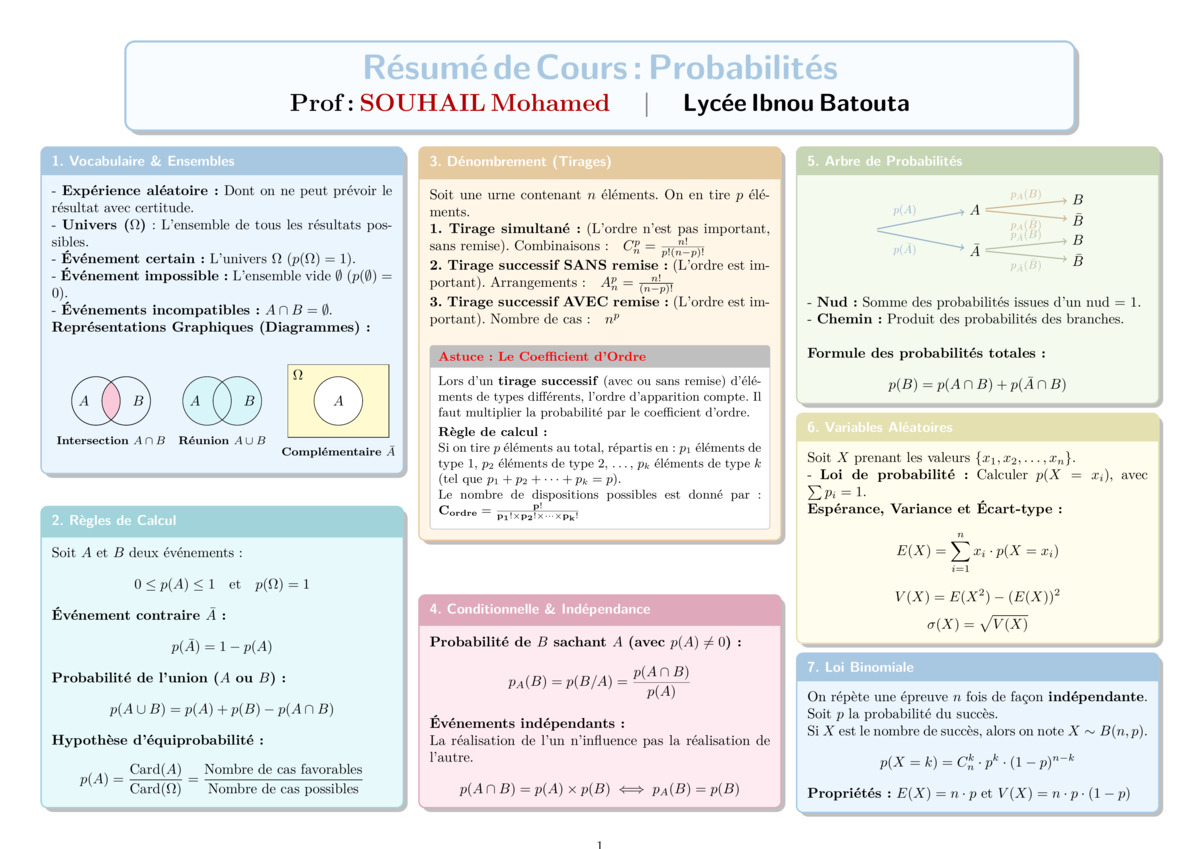
This PDF covers maths course for 2-bac-science students. Designed to help you master the topic efficiently.
\documentclass[10pt,landscape,a4paper]{article}
\usepackage[utf8]{inputenc}
\usepackage[T1]{fontenc}
\usepackage[french]{babel}
\usepackage[margin=1cm]{geometry}
\usepackage{amsmath,amssymb,amsfonts}
\usepackage{multicol}
\usepackage{tikz}
\usepackage{tikz-3dplot}
\usepackage[many]{tcolorbox}
\usepackage{xcolor}

% Custom Colors
\definecolor{myyellow}{HTML}{FFF9C4}
\definecolor{mycyan}{HTML}{B2EBF2}
\definecolor{mygreen}{HTML}{DCEDC8}
\definecolor{mypink}{HTML}{F8BBD0}
\definecolor{myblue}{HTML}{BBDEFB}
\definecolor{myorange}{HTML}{FFE0B2}

% Custom Box Styles
\tcbset{
    sectionbox/.style 2 args={
        colback=#1!30,
        colframe=#1!90!black,
        fonttitle=\bfseries\sffamily,
        title=#2,
        boxrule=1pt,
        arc=4pt,
        left=1.5mm, right=1.5mm, top=1.5mm, bottom=1.5mm,
        toptitle=1mm, bottomtitle=1mm,
        enhanced,
        drop shadow
    },
    examplebox/.style={
        colback=white,
        colframe=gray!50,
        fonttitle=\bfseries\small,
        coltitle=black,
        title=Astuce / Remarque,
        boxrule=0.5pt,
        arc=2pt,
        left=1mm, right=1mm, top=1mm, bottom=1mm,
        toptitle=0.5mm, bottomtitle=0.5mm,
        fontupper=\small
    }
}

\begin{document}

    % ==========================================
    % EN-TÊTE
    % ==========================================
    \begin{center}
        \begin{tcolorbox}[
            enhanced,
            colback=myblue!10,        % خلفية زرقاء فاتحة جداً ومريحة
            colframe=myblue!90!black, % إطار أزرق داكن (احترافي)
            arc=6pt,                  % زوايا دائرية
            boxrule=1.5pt,            % سمك الإطار
            drop shadow,              % ظل خفيف باش يبان الإطار بارز 3D
            width=0.85\textwidth,     % العرض مايشدش الورقة كاملة باش يجي متيول
            halign=center             % توسيط النص
            ]
            {\Huge \bfseries \textsf{\textcolor{myblue!90!black}{Résumé de Cours : Probabilités}}} \\
            \vspace{0.3cm}
            {\LARGE \bfseries Prof : \textcolor{red!70!black}{SOUHAIL Mohamed} \quad \textcolor{gray}{\textbf{|}} \quad \textsf{Lycée Ibnou Batouta}}
        \end{tcolorbox}
    \end{center}

    \begin{multicols}{3}

        % ==========================================
        % VOCABULAIRE & DIAGRAMMES
        % ==========================================
        \begin{tcolorbox}[sectionbox={myblue}{{1. Vocabulaire \& Ensembles}}]
            - \textbf{Expérience aléatoire :} Dont on ne peut prévoir le résultat avec certitude.\\
            - \textbf{Univers ($\Omega$)} : L'ensemble de tous les résultats possibles.\\
            - \textbf{Événement certain :} L'univers $\Omega$ ($p(\Omega) = 1$).\\
            - \textbf{Événement impossible :} L'ensemble vide $\emptyset$ ($p(\emptyset) = 0$).\\
            - \textbf{Événements incompatibles :} $A \cap B = \emptyset$.

        %   \vspace{0.2cm}
            \textbf{Représentations Graphiques (Diagrammes) :}
        %   \vspace{0.2cm}

            % DIAGRAMMES DE VENN
            \begin{center}
                \begin{tikzpicture}[scale=0.5]
                    % Intersection
                    \begin{scope}[shift={(-7.5,0)}]
                        \draw (0,0) circle (1.2);
                        \draw (1.5,0) circle (1.2);
                        \begin{scope}
                            \clip (0,0) circle (1.2);
                            \fill[mypink!80] (1.5,0) circle (1.2);
                        \end{scope}
                        \draw (0,0) circle (1.2);
                        \draw (1.5,0) circle (1.2);
                        \node at (-0.6,0) {$A$}; \node at (2.1,0) {$B$};
                        \node[below, font=\footnotesize\bfseries] at (0.75,-1.5) {Intersection $A \cap B$};
                    \end{scope}
                    % Union
                    \begin{scope}[shift={(-2,0)}]
                        \fill[mycyan!50] (0,0) circle (1.2);
                        \fill[mycyan!50] (1.5,0) circle (1.2);
                        \draw (0,0) circle (1.2);
                        \draw (1.5,0) circle (1.2);
                        \node at (-0.6,0) {$A$}; \node at (2.1,0) {$B$};
                        \node[below, font=\footnotesize\bfseries] at (0.75,-1.5) {Réunion $A \cup B$};
                    \end{scope}
                    % Complémentaire
                    \begin{scope}[shift={(4.5,0)}]
                        \fill[myyellow!80] (-2.5,-1.8) rectangle (2.5,1.8);
                        \fill[white] (0,0) circle (1.2);
                        \draw (-2.5,-1.8) rectangle (2.5,1.8);
                        \draw (0,0) circle (1.2);
                        \node at (0,0) {$A$};
                        \node at (-2, 1.3) {$\Omega$};
                        \node[below, font=\footnotesize\bfseries] at (0,-2) {Complémentaire $\bar{A}$};
                    \end{scope}
                \end{tikzpicture}
            \end{center}
        \end{tcolorbox}
        % ==========================================
        % RÈGLES DE BASE
        % ==========================================
        \begin{tcolorbox}[sectionbox={mycyan}{{2. Règles de Calcul}}]
            Soit $A$ et $B$ deux événements :
            $$ 0 \leq p(A) \leq 1 \quad \text{et} \quad p(\Omega) = 1 $$

            \textbf{Événement contraire $\bar{A}$ :}
            $$ p(\bar{A}) = 1 - p(A) $$

            \textbf{Probabilité de l'union ($A$ ou $B$) :}
            $$ p(A \cup B) = p(A) + p(B) - p(A \cap B) $$

            \textbf{Hypothèse d'équiprobabilité :}
            $$ p(A) = \frac{\text{Card}(A)}{\text{Card}(\Omega)} = \frac{\text{Nombre de cas favorables}}{\text{Nombre de cas possibles}} $$
        \end{tcolorbox}
        % ==========================================
        % ==========================================
        % DÉNOMBREMENT ET COEFFICIENT D'ORDRE
        % ==========================================
        \begin{tcolorbox}[sectionbox={myorange}{{3. Dénombrement (Tirages)}}]
            Soit une urne contenant $n$ éléments. On en tire $p$ éléments.

            \textbf{1. Tirage simultané :} (L'ordre n'est pas important, sans remise).
            $ \text{Combinaisons :} \quad C_n^p = \frac{n!}{p!(n-p)!} $

            \textbf{2. Tirage successif SANS remise :} (L'ordre est important).
            $ \text{Arrangements :} \quad A_n^p = \frac{n!}{(n-p)!} $

            \textbf{3. Tirage successif AVEC remise :} (L'ordre est important).
            $ \text{Nombre de cas :} \quad n^p $

            \vspace{0.2cm}

            % --- BOÎTE SPÉCIALE COEFFICIENT D'ORDRE ---
            \begin{tcolorbox}[examplebox, title={\color{red} \textbf{Astuce : Le Coefficient d'Ordre}}]
                Lors d'un \textbf{tirage successif} (avec ou sans remise) d'éléments de types différents, l'ordre d'apparition compte. Il faut multiplier la probabilité par le coefficient d'ordre.

                \vspace{0.1cm}
                \textbf{Règle de calcul :}\\
                Si on tire $p$ éléments au total, répartis en : $p_1$ éléments de type 1, $p_2$ éléments de type 2, \dots, $p_k$ éléments de type $k$ (tel que $p_1 + p_2 + \dots + p_k = p$).\\
                Le nombre de dispositions possibles est donné par :
                $ \mathbf{C_{ordre} = \frac{p!}{p_1! \times p_2! \times \dots \times p_k!}} $
            \end{tcolorbox}
        \end{tcolorbox}
        % ==========================================
        % PROBA CONDITIONNELLE
        % ==========================================
        \begin{tcolorbox}[sectionbox={mypink}{{4. Conditionnelle \& Indépendance}}]
            \textbf{Probabilité de $B$ sachant $A$ (avec $p(A) \neq 0$) :}
            $$ p_A(B) = p(B/A) = \frac{p(A \cap B)}{p(A)} $$

            \textbf{Événements indépendants :}\\
            La réalisation de l'un n'influence pas la réalisation de l'autre.
            $$ p(A \cap B) = p(A) \times p(B) \iff p_A(B) = p(B) $$
        \end{tcolorbox}
        % ==========================================
        % ARBRE DE PROBABILITÉS
        % ==========================================
        \begin{tcolorbox}[sectionbox={mygreen}{{5. Arbre de Probabilités}}]
            \begin{center}
                \begin{tikzpicture}[xscale=1.7, yscale=0.5, thick]
                    \node (R) at (0,0) {};
                    \node (A) at (1.5, 1) {$A$};
                    \node (Abar) at (1.5, -1) {$\bar{A}$};
                    \node (B1) at (3, 1.5) {$B$};
                    \node (Bbar1) at (3, 0.5) {$\bar{B}$};
                    \node (B2) at (3, -0.5) {$B$};
                    \node (Bbar2) at (3, -1.5) {$\bar{B}$};

                    \draw[->, myblue!80!black] (R) -- (A) node[midway, above left, scale=0.8]{$p(A)$};
                    \draw[->, myblue!80!black] (R) -- (Abar) node[midway, below left, scale=0.8]{$p(\bar{A})$};

                    \draw[->, myorange!80!black] (A) -- (B1) node[midway, above, scale=0.8]{$p_A(B)$};
                    \draw[->, myorange!80!black] (A) -- (Bbar1) node[midway, below, scale=0.8]{$p_A(\bar{B})$};

                    \draw[->, mygreen!80!black] (Abar) -- (B2) node[midway, above, scale=0.8]{$p_{\bar{A}}(B)$};
                    \draw[->, mygreen!80!black] (Abar) -- (Bbar2) node[midway, below, scale=0.8]{$p_{\bar{A}}(\bar{B})$};
                \end{tikzpicture}
            \end{center}

            - \textbf{Nœud :} Somme des probabilités issues d'un nœud = 1.\\
            - \textbf{Chemin :} Produit des probabilités des branches.\\

            \textbf{Formule des probabilités totales :}
            $$ p(B) = p(A \cap B) + p(\bar{A} \cap B) $$
        \end{tcolorbox}
        % ==========================================
        % VARIABLES ALÉATOIRES
        % ==========================================
        \begin{tcolorbox}[sectionbox={myyellow}{{6. Variables Aléatoires}}]
            Soit $X$ prenant les valeurs $\{x_1, x_2, \dots, x_n\}$.\\
            - \textbf{Loi de probabilité :} Calculer $p(X = x_i)$, avec $\sum p_i = 1$.

            \textbf{Espérance, Variance et Écart-type :}
            $$ E(X) = \sum_{i=1}^{n} x_i \cdot p(X = x_i) $$
            $$ V(X) = E(X^2) - (E(X))^2 $$
            $$ \sigma(X) = \sqrt{V(X)} $$
        \end{tcolorbox}
        % ==========================================
        % LOI BINOMIALE
        % ==========================================
        \begin{tcolorbox}[sectionbox={myblue}{{7. Loi Binomiale}}]
            On répète une épreuve $n$ fois de façon \textbf{indépendante}. Soit $p$ la probabilité du succès.\\
            Si $X$ est le nombre de succès, alors on note $X \sim B(n, p)$.
            $$ p(X = k) = C_n^k \cdot p^k \cdot (1 - p)^{n-k} $$

            \textbf{Propriétés :}
            $E(X) = n \cdot p$ et $V(X) = n \cdot p \cdot (1 - p)$
        \end{tcolorbox}

    \end{multicols}

\end{document}
✨ Get your own materials formatted with LaTeX
Explore more maths content for 2-bac-science:
Related Courses, Exams, and Exercises
Frequently Asked Questions
What will I learn by the end of this course?
You will gain a solid understanding of Résumés de cours de Pr: SOUHAIL Mohamed and be able to apply it in exams and real‑world problems.
What topics are covered in this course?
The course "Résumés de cours de Pr: SOUHAIL Mohamed" covers key concepts of maths for 2-bac-science. Designed to help students master the curriculum.
Is this course suitable for beginners?
Yes, the material is structured to be accessible while providing depth for advanced learners.
Are there exercises or practice problems?
Exercises are included to help you practice.
Does this course include solutions?
Solutions are available separately.
Download maths Course PDF (2-bac-science)
📄 Need LaTeX formatting?
Send me your homework, exam, or exercise content and I’ll turn it into a professional PDF.
Learn more →Recent Courses
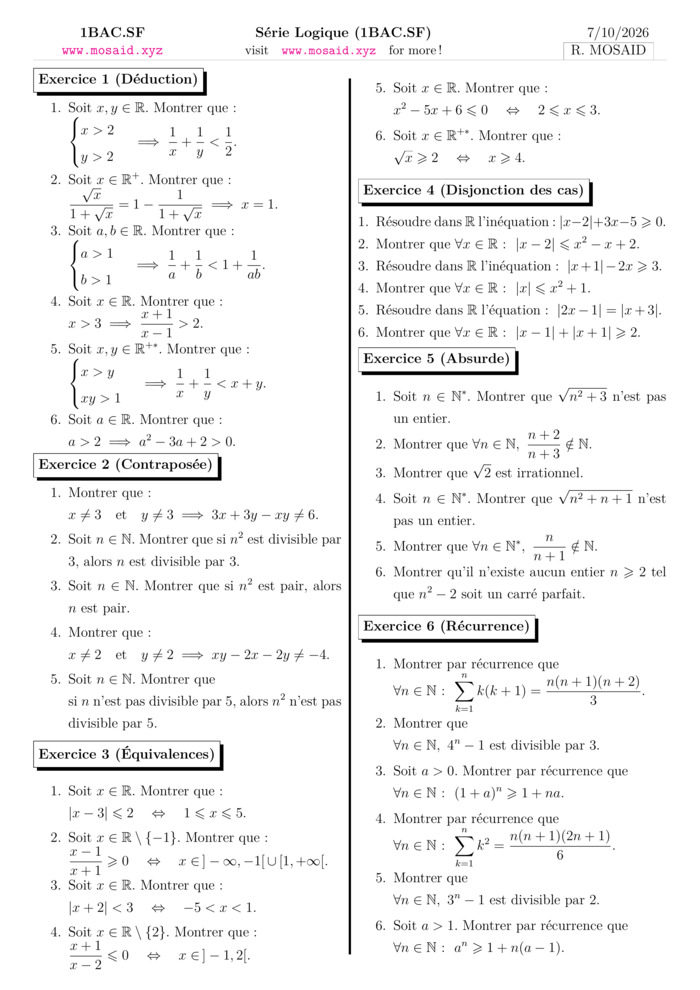
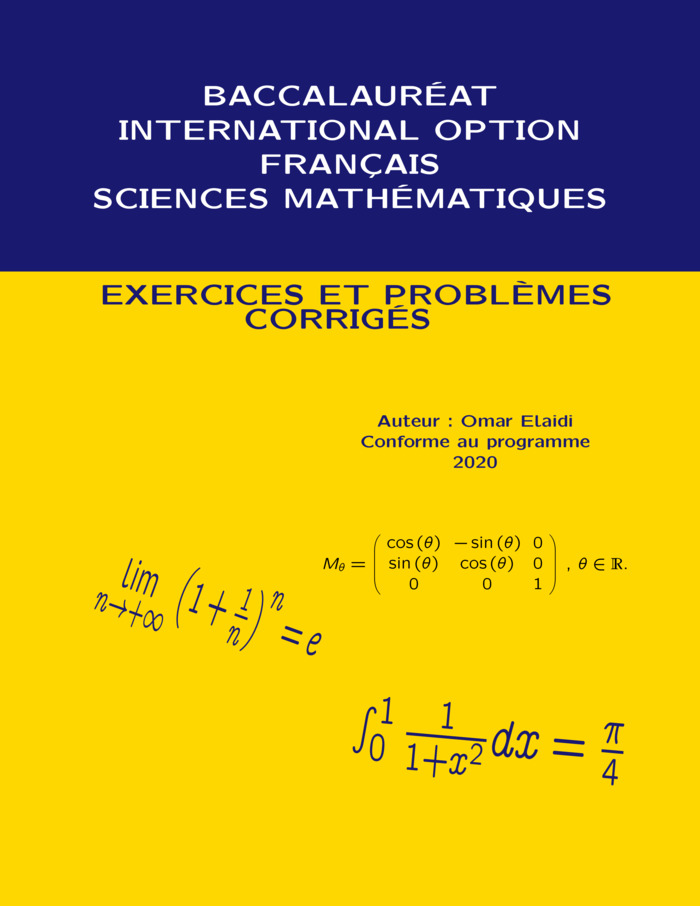
BACCALAURÉAT INTERNATIONAL SCIENCES MATHÉMATIQUES, OPTION FRANÇAIS
28 Sep 2026, 106 views
Course • Maths • 2 Bac Science Maths
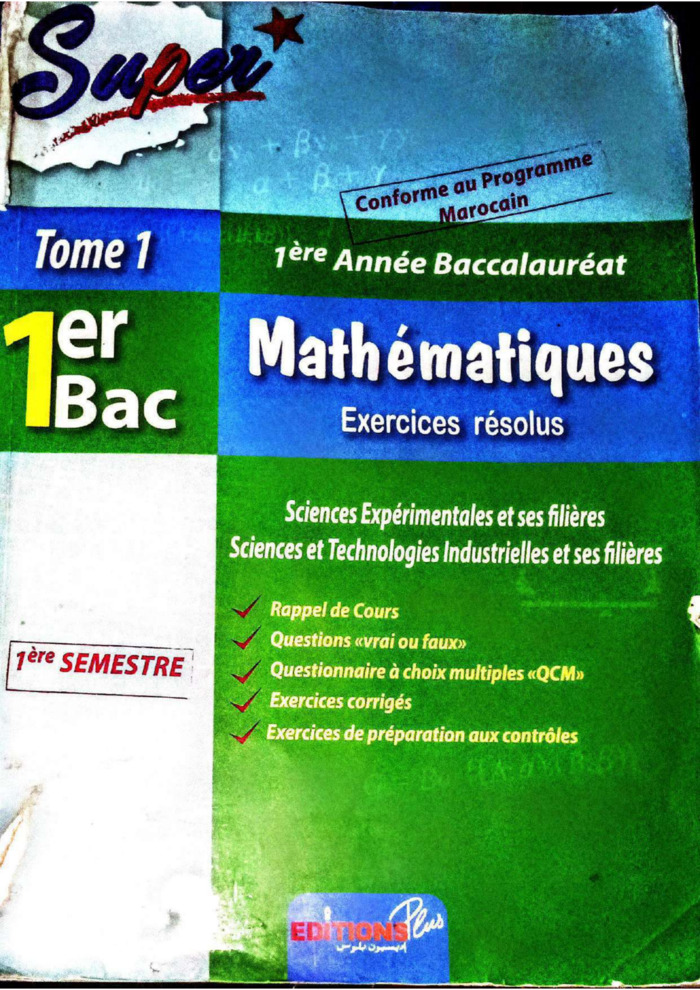
Terminal SE - Mathèmatiques: Cours et exercices
27 Sep 2026, 256 views
Course • Maths • 2 Bac Science
Most Viewed Courses
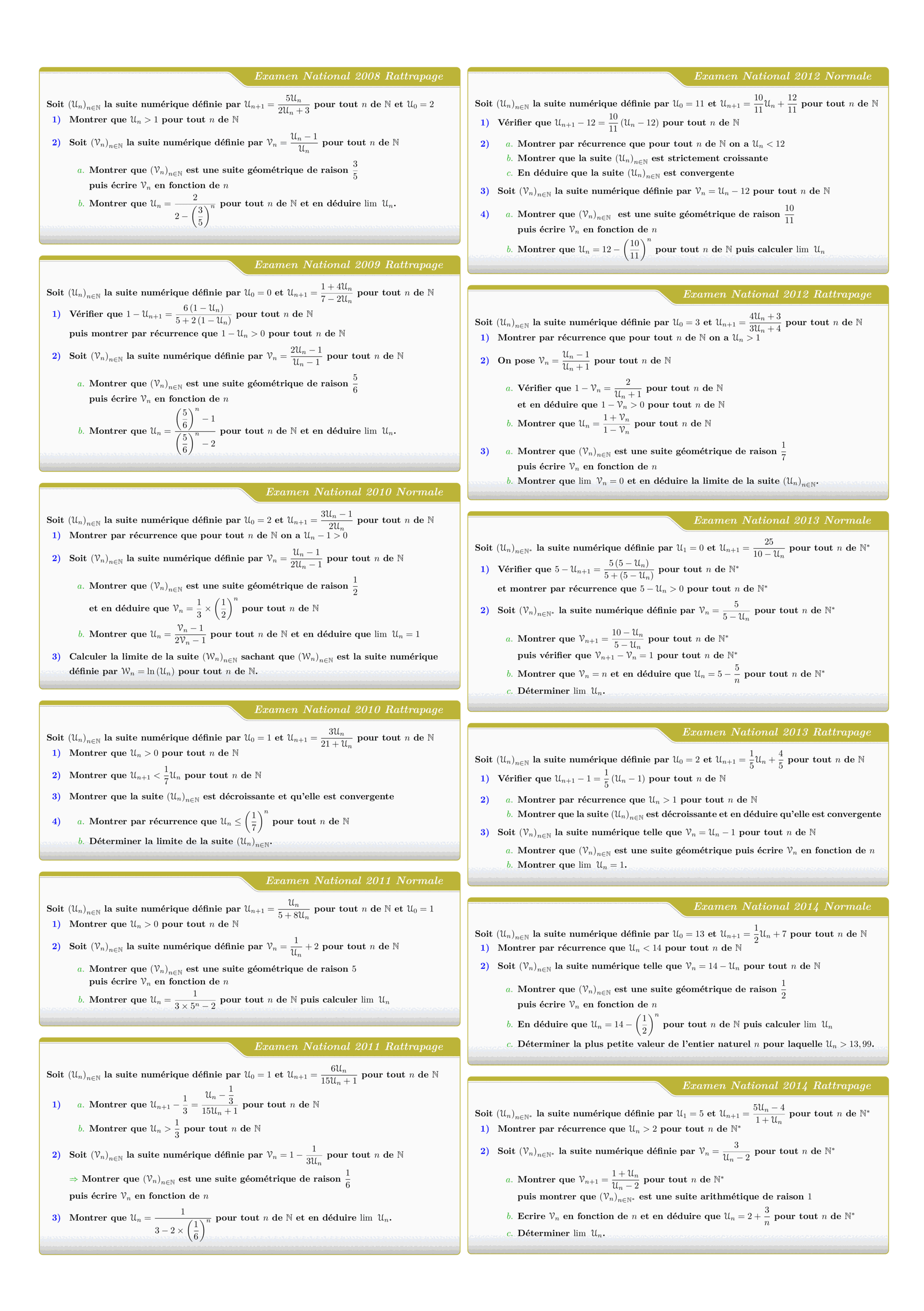
Tous les sujets des suites numériques des examens nationaux 2008 - 2022
Views: 3.12K
Exam • Maths • 2 Bac Science
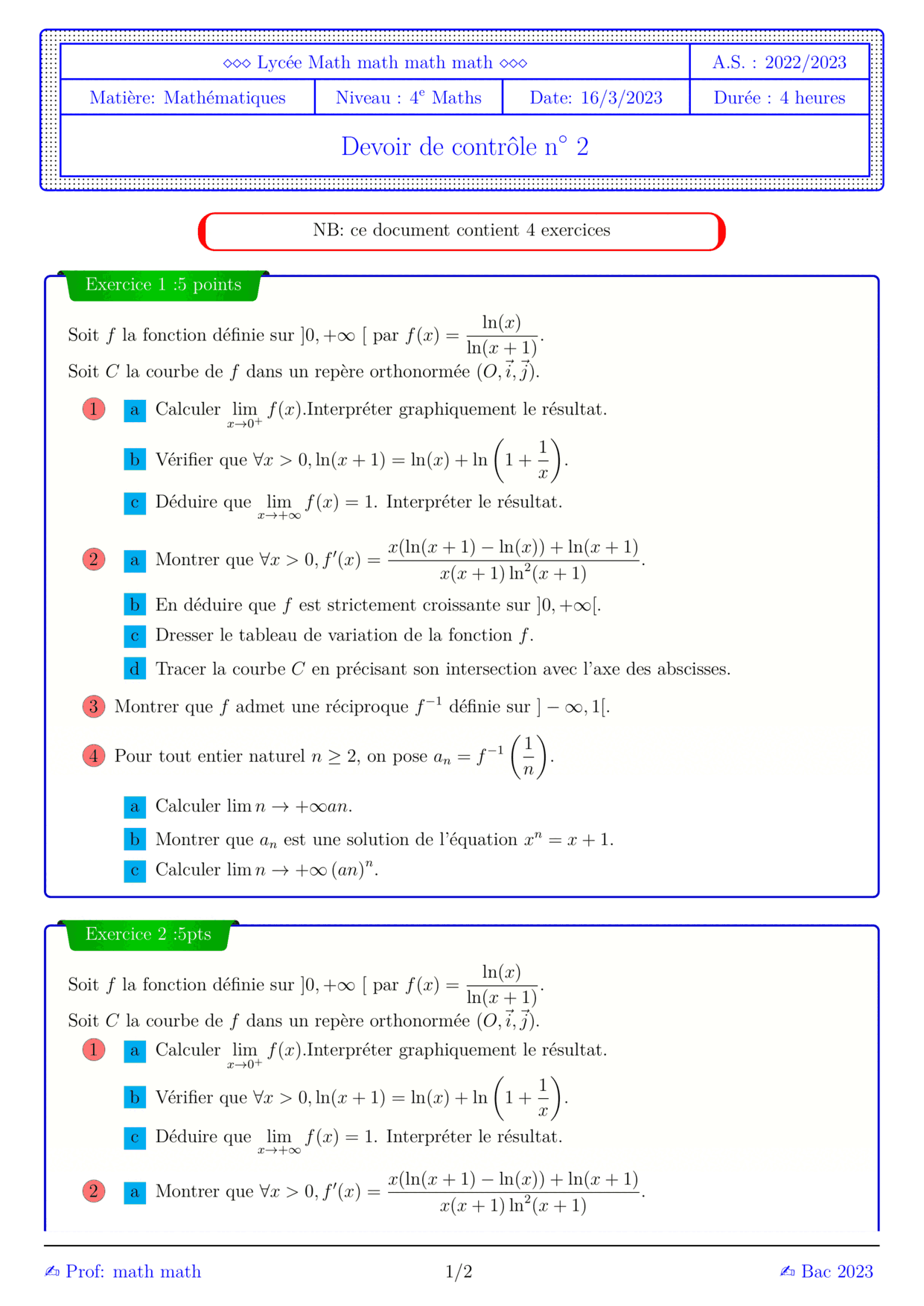

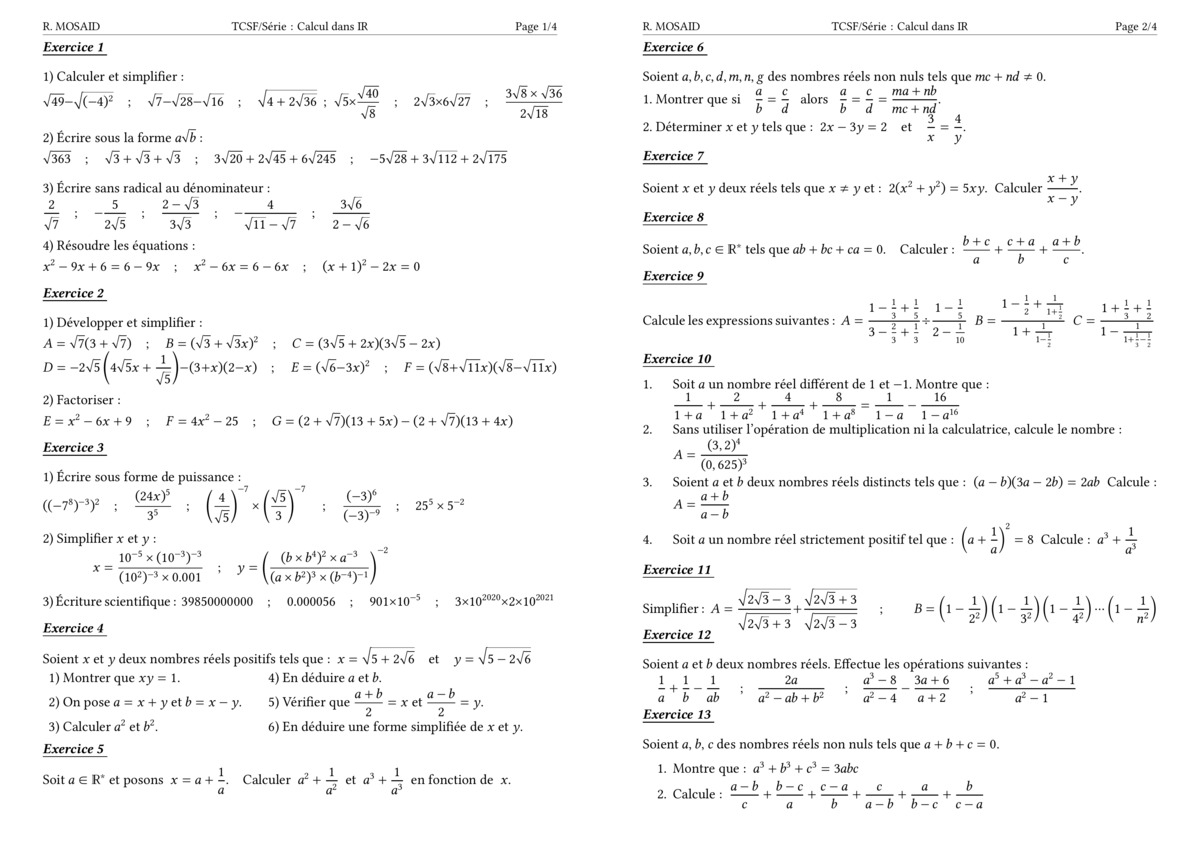
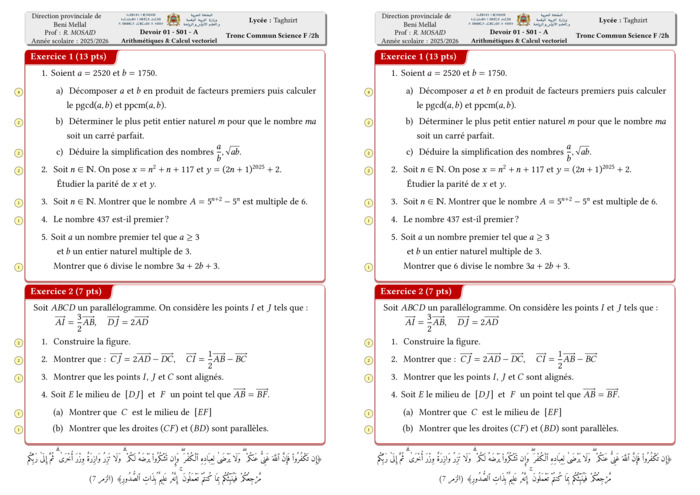
Control 01 S01 En arithmétiques et Calcul vectoriel - A 2025-2026
Views: 2.08K
Exam • Maths • Tronc Commun Sciences
MATHEMATIQUES Examens nationaux 2003-2021 2 Bac.Sciences expérimentales
Views: 1.97K
Exam • Maths • 2 Bac Science
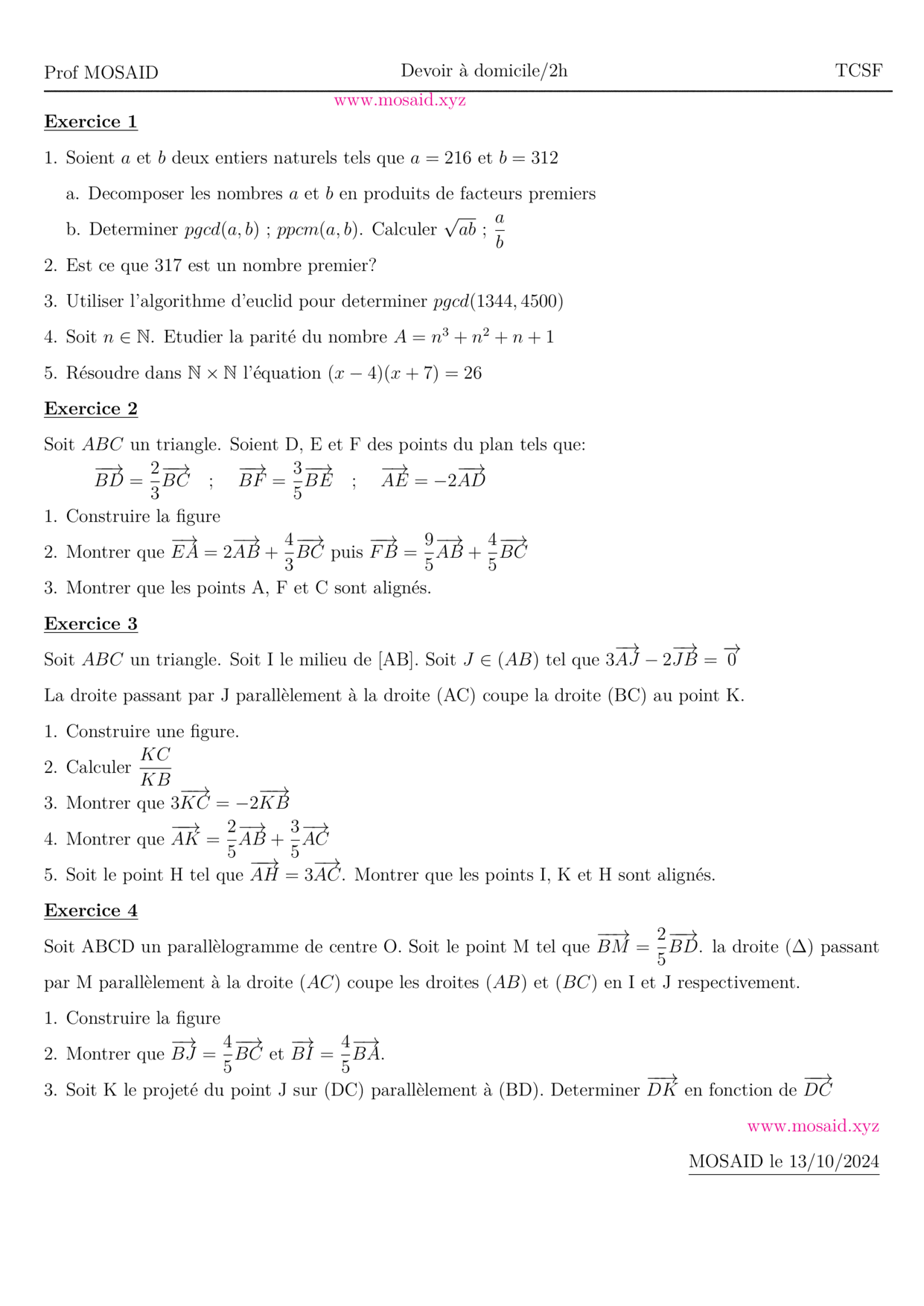
DM 1 - Arithmetiques, Calcul vectoriel et projection
Views: 1.93K
Exam • Maths • Tronc Commun Sciences
Recent Articles



Most Viewed Articles




The Ultimate Vim Setup (My 2024 vimrc ) : Essential Commands, Configurations, and Plugin Tips
Views: 1.47K
12 Apr 2024
Complete Tutorial: Creating Categories and Subcategories Using Pages in Pelican
Views: 1.12K
24 Jun 2025
Leave a comment