Devoir 1 de 1er bac sc.ex
📅 07 November 2026 👁️ المشاهدات: 1 ❓ 24 سؤال
📚 الدروس التي يشملها هذا الامتحان:
📄 ماذا ستجد في هذه الصفحة؟
• ملف الامتحان بصيغة PDF يمكنك معاينته هنا مباشرةً دون تنزيله.
• يمكنك تنزيل الملف من زر التحميل أسفل الصفحة والاحتفاظ به على جهازك.
• ستجد أيضًا دروسًا وامتحانات وتمارين ذات صلة تساعدك على المراجعة وتعميق الفهم.
• هذا الامتحان يحتوي على عدد الأسئلة: 24.
• أُدرج مصدر LaTeX الكامل أسفل الصفحة لتتمكن من الاطلاع عليه أو تعديله والاستفادة منه.
• هل تحتاج تنسيقًا احترافيًا لموادك الخاصة؟ أقدم خدمة كتابة LaTeX — أرسل المحتوى المطلوب لتحصل على ملف PDF منسق وملف المصدر.
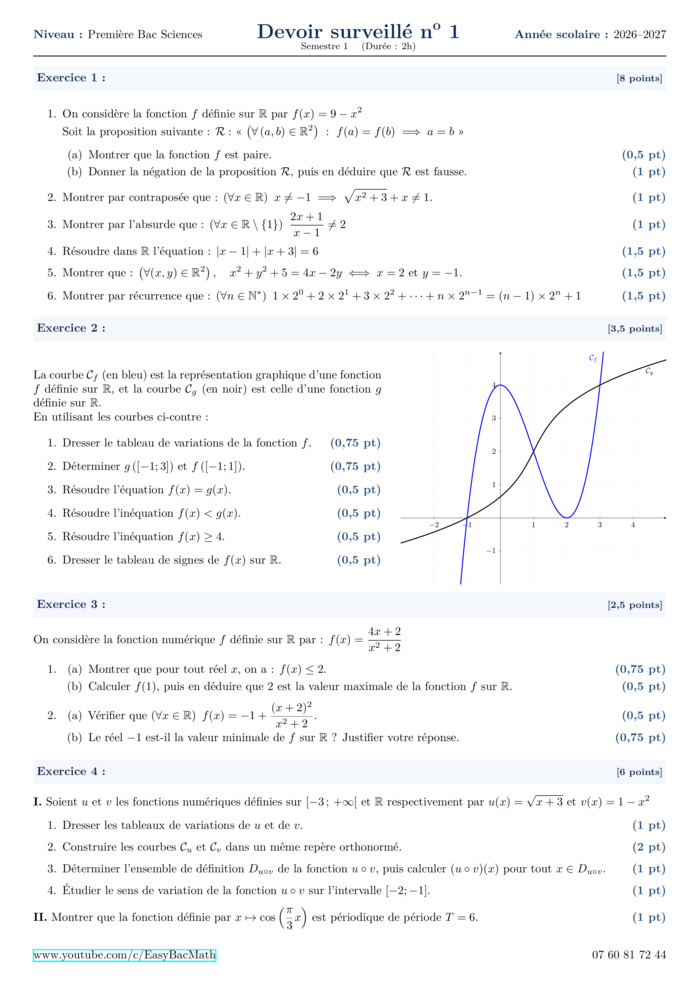
الامتحان في مادة maths للمستوى 1-bac-science. يضم الملف عدد الأسئلة: 24. يمكنك قراءة الملف أو تنزيله مباشرةً بصيغة PDF.
\documentclass[10pt,a4paper]{article}
\usepackage[a4paper,top=0.7cm,bottom=2cm,left=1cm,right=1cm]{geometry}
\usepackage[T1]{fontenc}
\usepackage{lmodern}
\usepackage{microtype}
\usepackage{amsmath,amssymb,amsthm,mathtools}
\usepackage{tabularx,booktabs}
\usepackage{xcolor}
\usepackage{enumitem}
\linespread{1}

\definecolor{primary}{RGB}{16, 44, 87}
\definecolor{secondary}{RGB}{40, 80, 130}
\definecolor{lightbg}{RGB}{244, 247, 251}

\setlength{\parindent}{0pt}
\setlength{\parskip}{3pt}

\newcommand{\pts}[1]{\hfill \mbox{\textbf{\textcolor{secondary}{(#1)}}}}

\newcommand{\exercice}[2]{%
  \vspace{3pt}%
  \noindent\colorbox{lightbg}{%
    \parbox{\dimexpr\textwidth-2\fboxsep\relax}{%
      \vspace{3pt}%
      \textbf{\textcolor{primary}{\normalsize #1}} \hfill \textbf{\textcolor{primary}{\footnotesize [#2]}}%
      \vspace{3pt}%
    }%
  }%
  \vspace{5pt}%
}

\usepackage{fancyhdr}
\pagestyle{fancy}
\fancyhead{}
\fancyfoot{}
\fancyhead[L]{}
\fancyhead[C]{}
\fancyhead[R]{}
\fancyfoot[L]{\href{http://www.youtube.com/c/EasyBacMath}{\textcolor{black}{www.youtube.com/c/EasyBacMath}}}
\fancyfoot[C]{\empty}
\fancyfoot[R]{$07\ 60\ 81\ 72\ 44$}
\usepackage{pgfplots}
\pgfplotsset{compat=1.18}
\usetikzlibrary{arrows}
\usepackage{graphicx}
\usepackage{hyperref}
\begin{document}
\everymath{\displaystyle}
% ================= EN-TÊTE =================
\noindent
\begin{tabularx}{\textwidth}{@{}l >{\centering\arraybackslash}X r@{}}
\textbf{\textcolor{primary}{Niveau :}} Première Bac Sciences &
\textbf{\LARGE \textcolor{primary}{Devoir surveillé n\textsuperscript{o} 1}} \par \footnotesize Semestre 1 \quad (Durée : 2h) &
\textbf{\textcolor{primary}{Année scolaire :}} 2026--2027 \\
\bottomrule
\end{tabularx}
\vspace{1pt}

% ================= EXERCICE 1 =================
\exercice{Exercice 1 :}{8 points}
\begin{enumerate}
    \item On considère la fonction $f$ définie sur $\mathbb{R}$ par $f(x)=9-x^2$

    Soit la proposition suivante : $\mathcal{R} : $ \guillemotleft~$\left( \forall\left( a,b \right) \in \mathbb{R}^2 \right) \ : \ f(a)=f(b) \implies a=b$~\guillemotright

    \begin{enumerate}
        \item Montrer que la fonction $f$ est paire.  \pts{0,5 pt}
        \item Donner la négation de la proposition $\mathcal{R}$, puis en déduire que $\mathcal{R}$ est fausse. \pts{1 pt}
    \end{enumerate}


    \item Montrer par contraposée que : \(\left( \forall x \in \mathbb{R} \right) \  x\neq -1 \implies \sqrt{x^2+3}+x \neq 1\). \pts{1 pt}
    \item Montrer par l'absurde que :
    \( \left( \forall x \in \mathbb{R}\setminus\{ 1 \} \right) \
    \frac{2x+1}{x-1} \neq 2
    \) \pts{1 pt}

    \item Résoudre dans $\mathbb{R}$ l'équation : \( |x-1|+|x+3|=6 \) \pts{1,5 pt}
    \item Montrer que : $\left(\forall(x,y)\in \mathbb{R}^2\right), \quad x^2+y^2+5 = 4x-2y \iff x = 2 \text{ et } y = -1$. \pts{1,5 pt}

    \item Montrer par récurrence que :
        \( \left( \forall n \in \mathbb{N}^{*} \right) \
        1\times 2^{0}+2\times 2^1+3\times 2^2+\cdots+n\times 2^{n-1} =(n-1)\times 2^n+1
        \) \pts{1,5 pt}
\end{enumerate}

% ================= EXERCICE 2 =================
\exercice{Exercice 2 :}{3,5 points}

\begin{minipage}[c]{0.55\textwidth}
La courbe \(\mathcal{C}_f\) (en bleu) est la représentation graphique d'une fonction \(f\) définie sur \(\mathbb R\), et la courbe \(\mathcal{C}_g\) (en noir) est celle d'une fonction \(g\) définie sur \(\mathbb R\).

En utilisant les courbes ci-contre :

\begin{enumerate}
    \item Dresser le tableau de variations de la fonction \(f\). \pts{0,75 pt}
    \item Déterminer $g\left([-1;3]\right)$ et $f\left([-1;1]\right)$. \pts{0,75 pt}
    \item Résoudre l'équation \(f(x)=g(x)\). \pts{0,5 pt}
    \item Résoudre l'inéquation \(f(x) < g(x)\). \pts{0,5 pt}
    \item Résoudre l'inéquation \(f(x)\ge 4\). \pts{0,5 pt}
    \item Dresser le tableau de signes de \(f(x)\) sur \(\mathbb R\). \pts{0,5 pt}
\end{enumerate}
\end{minipage}
\hfill
\begin{minipage}[c]{0.42\textwidth}
\centering
\resizebox{\linewidth}{!}{%
\begin{tikzpicture}[line cap=round,line join=round,>=triangle 45,x=1.5cm,y=1.5cm]
\begin{axis}[
    x=1.5cm,y=1.5cm,
    axis lines=middle,
    xmin=-3,
    xmax=5,
    ymin=-2,
    ymax=5,
    xtick={-2,...,4},
    ytick={-1,...,4},
    clip=true,
    grid=both,
    grid style={dotted, gray!50},
    major grid style={dotted, gray!50},
    minor grid style={dotted, gray!30},
    legend style={font=\small, fill=none, draw=none, at={(0.98,0.02)}, anchor=south east},
    legend cell align=left,
]

\addplot[
    black,
    very thick,
    parametric,
    domain=-5:5,
    variable=\t,
    samples=600
]
({((\t-2)^3)/8 + \t/2}, {\t});

\addplot[
    blue,
    very thick,
    domain=-5:5,
    samples=600
]
{x^3 - 3*x^2 + 4};
\draw (axis cs:4.3,4.6) node[anchor=north west] {\(\mathcal{C}_g\)};
\draw (axis cs:2.6,4.6) node[anchor=south west] {\textcolor{blue}{\(\mathcal{C}_f\)}};
\end{axis}
\end{tikzpicture}%
}
\end{minipage}

% ================= EXERCICE 3 =================
\exercice{Exercice 3 :}{2,5 points}

On considère la fonction numérique $f$ définie sur $\mathbb{R}$ par :
\(
f(x) = \dfrac{4x+2}{x^2+2}
\)

\begin{enumerate}
    \item
    \begin{enumerate}
        \item Montrer que pour tout réel $x$, on a : $f(x) \le 2$. \pts{0,75 pt}
        \item Calculer $f(1)$, puis en déduire que $2$ est la valeur maximale de la fonction $f$ sur $\mathbb{R}$. \pts{0,5 pt}
    \end{enumerate}
    \item
    \begin{enumerate}
        \item Vérifier que \( \left( \forall x \in \mathbb{R} \right) \ f(x) = -1 + \dfrac{(x+2)^2}{x^2+2} \). \pts{0,5 pt}
        \item Le réel $-1$ est-il la valeur minimale de $f$ sur $\mathbb{R}$ ? Justifier votre réponse. \pts{0,75 pt}
    \end{enumerate}
\end{enumerate}

% ================= EXERCICE 4 =================
\exercice{Exercice 4 :}{6 points}

    \textbf{I.} Soient \(u\) et \(v\) les fonctions numériques définies sur $[-3\,;\,+\infty[$ et $\mathbb R$ respectivement par \(u(x)=\sqrt{x+3}\text{ et } v(x)=1-x^2\)
    \begin{enumerate}
        \item Dresser les tableaux de variations de $u$ et de $v$. \pts{1 pt}
        \item Construire les courbes $\mathcal{C}_u$ et $\mathcal{C}_v$ dans un même repère orthonormé. \pts{2 pt}
        \item Déterminer l'ensemble de définition $D_{u \circ v}$ de la fonction $u \circ v$, puis calculer $(u \circ v)(x)$ pour tout $x \in D_{u \circ v}$. \pts{1 pt}
        \item Étudier le sens de variation de la fonction $u \circ v$ sur l'intervalle $[ -2 ; -1]$. \pts{1 pt}
    \end{enumerate}

    \textbf{II.} Montrer que la fonction définie par $ x \mapsto \cos\left(\dfrac{\pi}{3}x\right)$  est périodique de période $T = 6$. \pts{1 pt}

\end{document}
موارد ذات صلة: دروس وامتحانات وتمارين
يمكنك الاطلاع على المزيد من موارد maths للمستوى 1-bac-science.
📄 هل تحتاج تنسيقًا بـ LaTeX؟
أرسل لي واجبك أو امتحانك أو تمارينك وسأحوّلها إلى ملف PDF احترافي.
اعرف المزيد ←أحدث الدروس
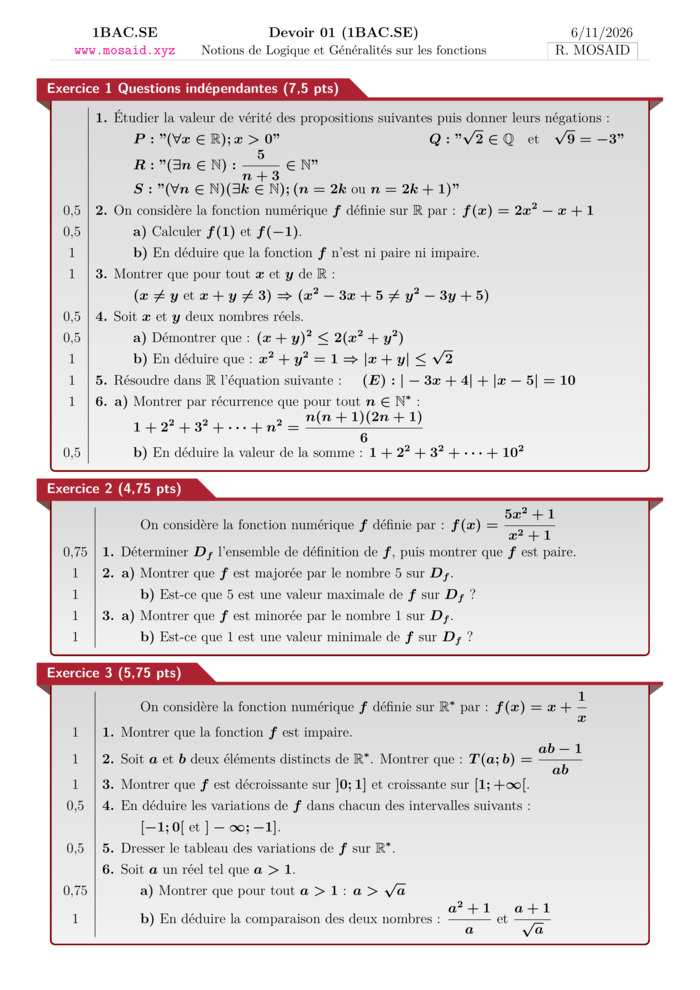
Devoir 01 (1BAC.SE) -- Notions de Logique et Généralités sur les fonctions
06 Nov 2026 • 105 views
امتحان • Maths • 1 Bac Science
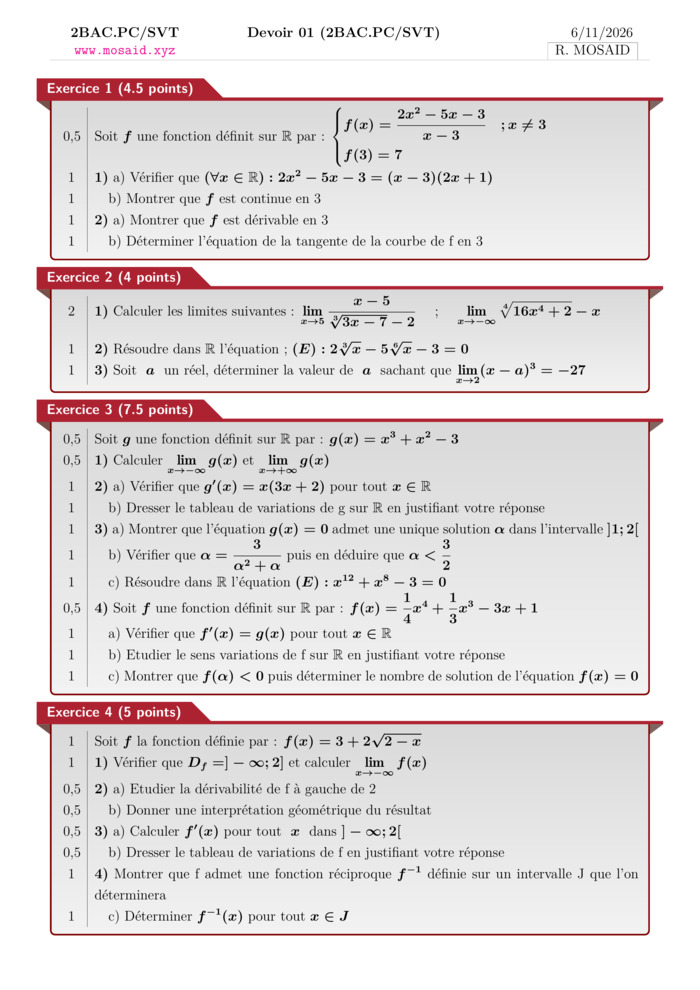
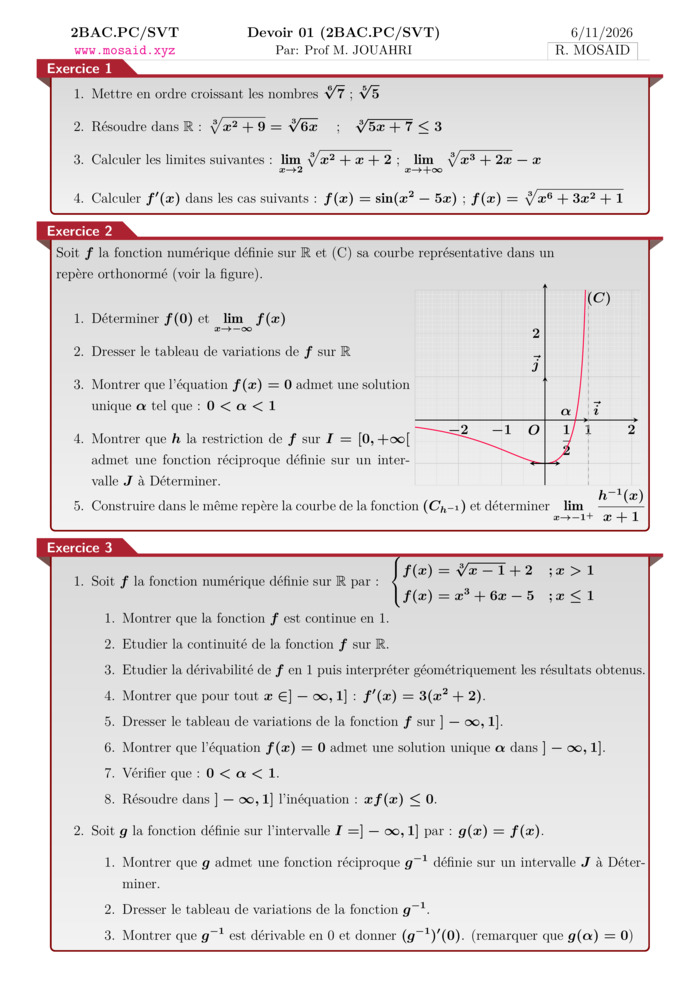

Solution — serie exercices: Calcul dans IR et Ordre
05 Nov 2026 • 1 views
حل • Maths • Tronc Commun Sciences
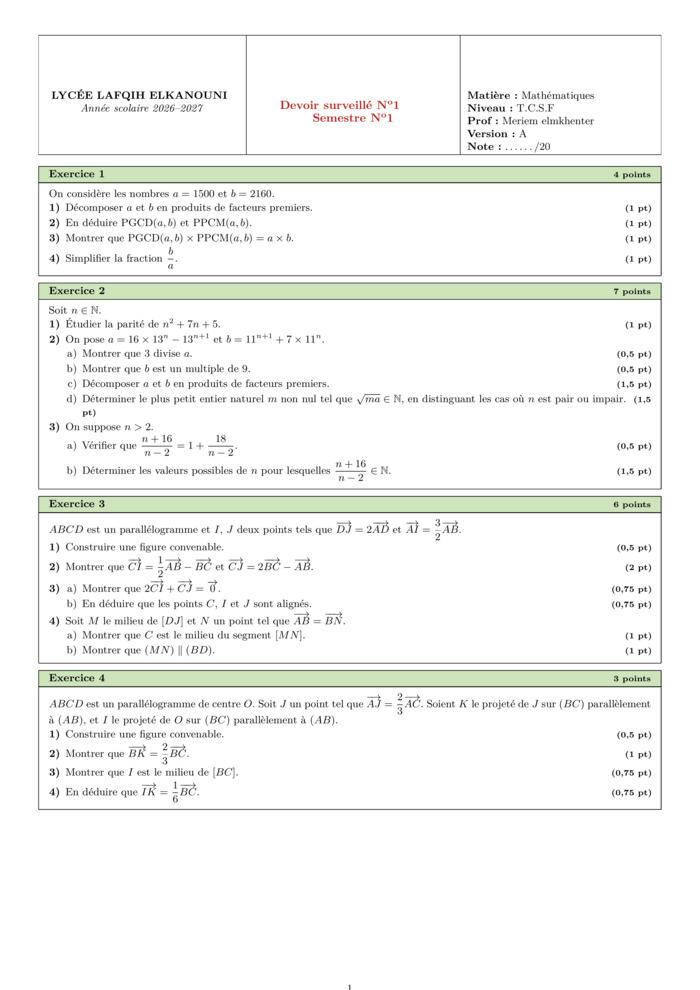
Devoir 01S01 ABCD PAR Meriem elmkhenter
04 Nov 2026 • 42 views
امتحان • Maths • Tronc Commun Sciences
الأكثر مشاهدة
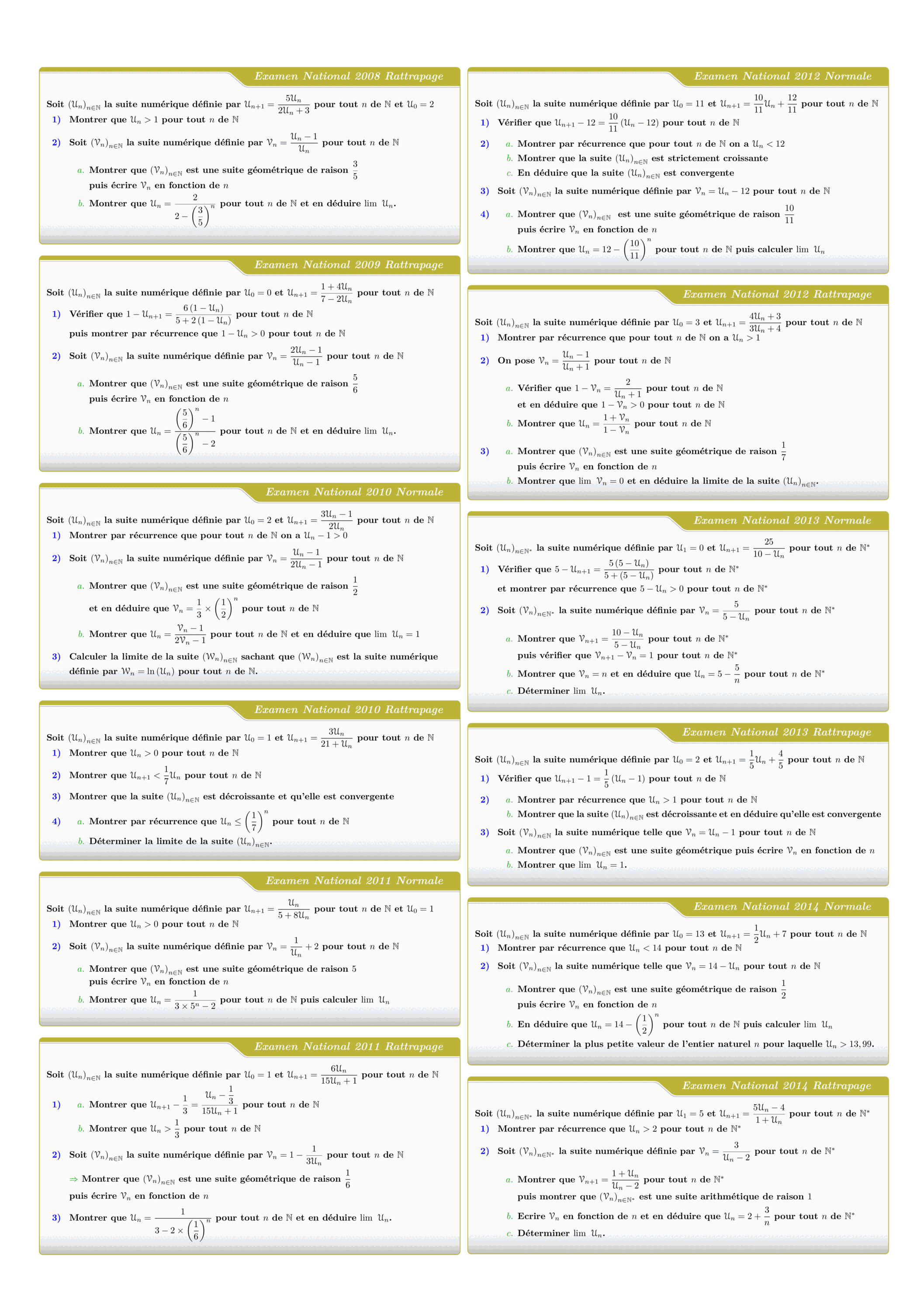
Tous les sujets des suites numériques des examens nationaux 2008 - 2022
views: 3.15K
امتحان • Maths • 2 Bac Science
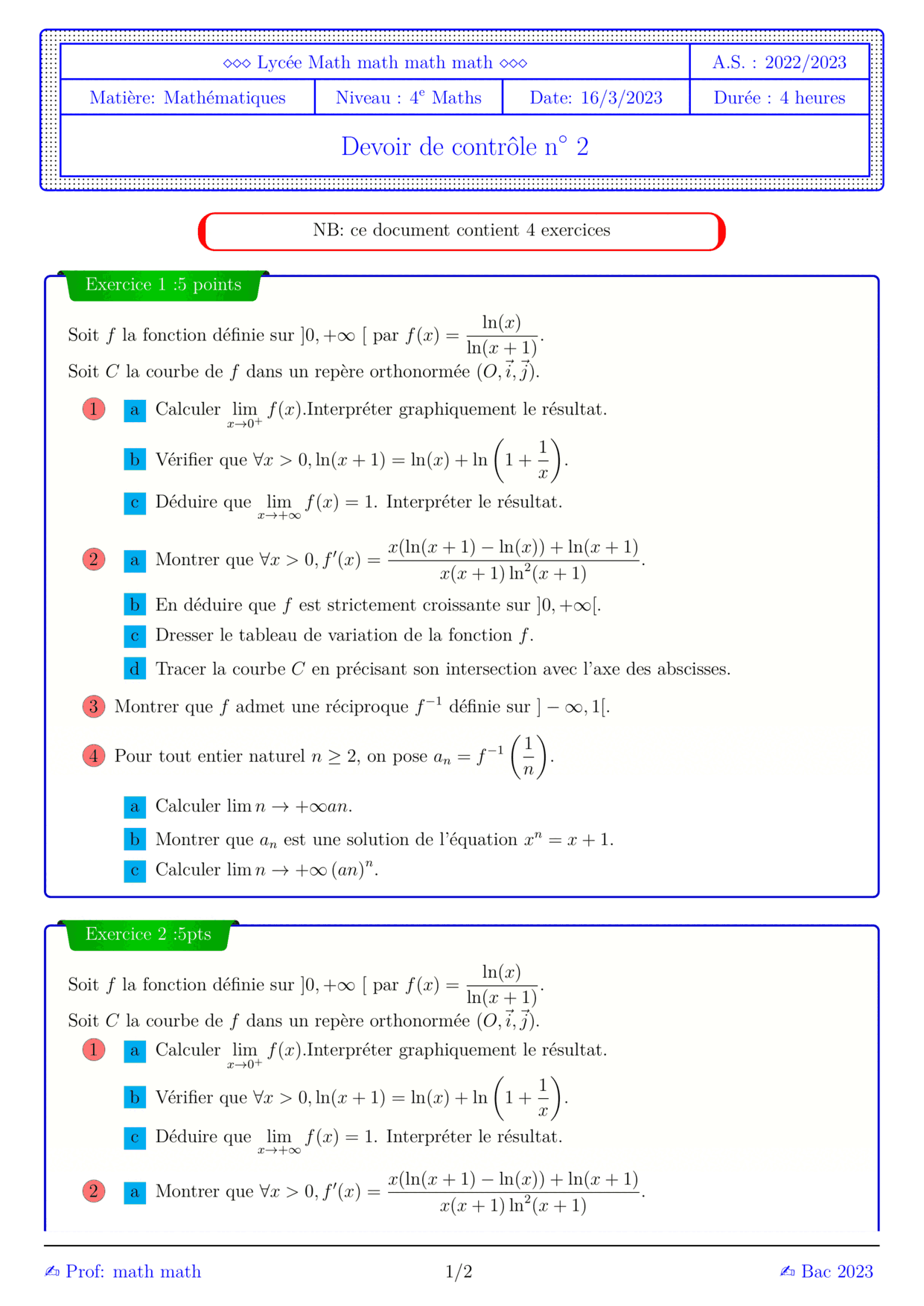

Control 01 S01 En arithmétiques et Calcul vectoriel - A 2025-2026
views: 2.16K
امتحان • Maths • Tronc Commun Sciences
DM 1 - Arithmetiques, Calcul vectoriel et projection
views: 1.99K
امتحان • Maths • Tronc Commun Sciences
MATHEMATIQUES Examens nationaux 2003-2021 2 Bac.Sciences expérimentales
views: 1.98K
امتحان • Maths • 2 Bac Science
Recent Articles




Most Viewed Articles



The Ultimate Vim Setup (My 2024 vimrc ) : Essential Commands, Configurations, and Plugin Tips
Views: 1.49K
12 Apr 2024

Complete Tutorial: Creating Categories and Subcategories Using Pages in Pelican
Views: 1.14K
24 Jun 2025
اترك تعليقًا