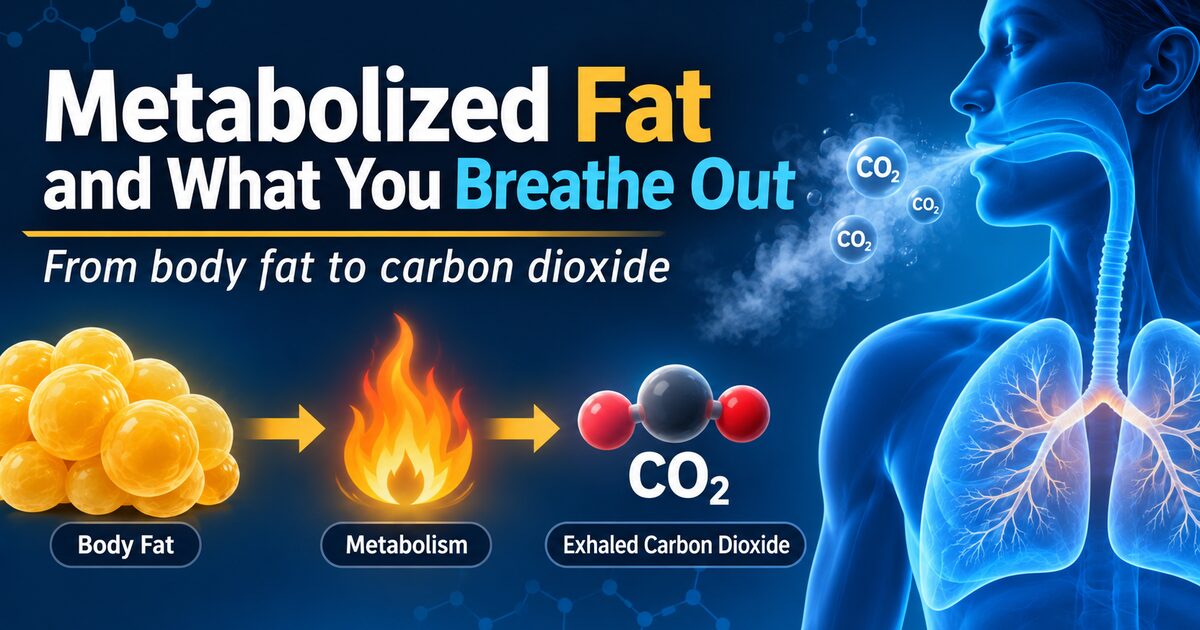
Where Does Metabolized Body Fat Go? The Chemistry of Exhalation
There is a persistent misconception about what happens to stored body fat when the body uses it for energy. People often assume that it is converted mainly into heat, or that most of it leaves the body through sweat. Neither description captures the underlying chemistry.
When stored fat is metabolized, most of the mass of the original fat molecules ultimately leaves the body as carbon dioxide, which is exhaled through the lungs. The remainder becomes water and leaves through ordinary water-loss pathways.
This is not a metaphor or a breathing trick. It follows from the conservation of mass and the chemical reactions involved in aerobic metabolism. Understanding the process also helps separate a sound biochemical explanation from several misleading conclusions that are sometimes attached to it.
1. The chemical destination of stored fat
Much of the energy stored in adipose tissue is held in molecules called triglycerides. A triglyceride contains carbon, hydrogen and oxygen. When the body needs energy, it can release fatty acids from stored triglycerides and use them in metabolic pathways that ultimately transfer energy into forms cells can use.
In aerobic metabolism, the carbon and hydrogen atoms from fatty acids are converted mainly into carbon dioxide and water. Oxygen participates in these reactions, and the process releases energy. The carbon dioxide is transported in the blood to the lungs, where it is removed during exhalation. Water joins the body's existing water pool and is eventually lost through several routes.
2. What the 84% and 16% figures mean
A widely cited 2014 paper by Ruben Meerman and Andrew Brown used the chemistry of fat oxidation to explain the fate of body-fat mass. Its often-quoted result is that, for a representative amount of metabolized fat, approximately 84% of the original fat mass is converted into carbon dioxide and approximately 16% into water.
The distinction matters because the oxygen inhaled during metabolism also contributes atoms and mass to the resulting carbon dioxide and water. The carbon dioxide leaving the lungs is therefore not made solely from the original fat. The percentage refers to where the atoms from the fat itself end up.
For the same reason, it is misleading to interpret the figure as saying that 84% of all body weight lost is exhaled. Body weight changes also reflect water balance, digestive contents and other components. The calculation concerns the fate of metabolized fat molecules.
3. Why the lungs are central to the process
The lungs are not where fat is chemically broken down. Most of the relevant reactions occur inside cells, particularly through pathways that include mitochondrial fatty-acid oxidation and the citric acid cycle. The lungs provide the exchange surface that brings oxygen into the body and removes carbon dioxide produced by metabolism.
Carbon dioxide is carried in blood in several forms, with most transported as bicarbonate ions. In the lungs, the chemistry reverses sufficiently to regenerate carbon dioxide, which diffuses into the air in the alveoli and is exhaled.
Breathing is therefore the final removal step for much of the carbon originating in metabolized fat. It is not a direct process of breathing fat out of the body.
4. What happens during rest, sleep and activity?
Metabolism does not switch off when a person is sitting quietly or sleeping. Cells continuously require energy to maintain electrical gradients, repair and replace components, regulate temperature, move substances and support organ function. The body draws on a mixture of fuels, including carbohydrates and fatty acids, with the proportions changing according to physiological conditions.
During physical activity, energy demand rises. The respiratory and circulatory systems respond by delivering more oxygen and transporting more carbon dioxide away from active tissues. Depending on exercise intensity, duration, recent food intake and other factors, the body changes the relative contribution of carbohydrate and fat to energy production.
It is important not to confuse increased breathing with increased fat loss. Breathing rate rises to meet the body's gas-exchange requirements. Deliberately breathing faster does not independently force the body to oxidize more stored fat, and holding one's breath is not a useful way to influence the process.
5. The energy and mass balance are related—but not identical
Metabolism releases usable energy from chemical bonds, but the atoms do not disappear. The body rearranges them into other molecules. This is a straightforward application of conservation of mass: the atoms entering a set of chemical reactions must be accounted for in the products, even though oxygen from the air contributes to those products.
Energy balance and the chemical fate of fat are connected, but they answer different questions. Energy balance concerns the relationship between energy entering the body and energy expended over time. The 84/16 calculation describes the approximate chemical destination of the atoms in fat that has already been metabolized. It does not, by itself, predict whether a person's body mass or body composition will change.
Most of the mass of metabolized fat leaves as carbon dioxide—not because the lungs burn fat, but because they remove a major end product of cellular metabolism.
6. Common misconceptions
Does sweat carry most of the fat away? No. Sweat is primarily a mechanism for temperature regulation. Water produced during metabolism can leave in sweat, but the carbon from metabolized fat is largely eliminated as carbon dioxide.
Does breathing harder make the body use more fat? Not on its own. Ventilation responds to metabolic demand; changing breathing deliberately is not a substitute for the biochemical processes that oxidize fuels.
Does all exhaled carbon dioxide come from body fat? No. Carbon dioxide is produced when the body metabolizes several fuels, including carbohydrates and fats. The proportion attributable to each fuel changes with the body's condition.
Does the 84/16 ratio describe every person's weight change? No. It is an approximate chemical accounting for the fate of metabolized fat. It is not a universal daily weight-loss ratio, and it does not include every factor that affects scale weight.
7. The bigger picture
The respiratory system is usually discussed in terms of oxygen delivery and carbon dioxide removal. That description is correct, but it also reveals an unexpected connection: the lungs are one of the main routes through which the carbon atoms from metabolized stored fat leave the body.
Stored triglycerides are broken down and oxidized in cells. Their atoms are rearranged into carbon dioxide and water; oxygen from inhaled air participates in the reactions; and energy is released for cellular work. Blood carries carbon dioxide to the lungs, where it is exhaled, while water joins the body's water pool and is lost through normal routes.
The key insight is not that breathing is a weight-management technique. It is that metabolism obeys chemistry: the mass of stored fat is transformed, and much of its carbon leaves the body through exhalation.
Scientific reference
Ruben Meerman and Andrew J. Brown, “When Somebody Loses Weight, Where Does the Fat Go?”, BMJ, 2014; 349: g7257. The paper explains the stoichiometry of fat oxidation and the roles of carbon dioxide and water in the products of metabolism.
The percentages in this article are approximate and describe the fate of the original mass of metabolized fat. They should not be interpreted as a prediction of individual weight change or as a recommendation to alter breathing or exercise behavior.
Recent Articles

A Conky Classroom Clock for Tracking Lesson Time
19 Nov 2026

A Tiny Bash Todo List That Greets Every Terminal
19 Nov 2026



Most Viewed Articles





The Ultimate Vim Setup (My 2024 vimrc ) : Essential Commands, Configurations, and Plugin Tips
Views: 1.50K
12 Apr 2024


Complete Tutorial: Creating Categories and Subcategories Using Pages in Pelican
Views: 1.15K
24 Jun 2025
Leave a comment