Solution Control n 2: Calcul et ordre dans IR et droite dans le plan (A)
📅 17 December 2024 👁️ المشاهدات: 653
📄 ماذا ستجد في هذه الصفحة؟
• ملف الحل بصيغة PDF يمكنك معاينته هنا مباشرةً دون تنزيله.
• يمكنك تنزيل الملف من زر التحميل أسفل الصفحة والاحتفاظ به على جهازك.
• ستجد أيضًا دروسًا وامتحانات وتمارين ذات صلة تساعدك على المراجعة وتعميق الفهم.
• أُدرج مصدر LaTeX الكامل أسفل الصفحة لتتمكن من الاطلاع عليه أو تعديله والاستفادة منه.
• هل تحتاج تنسيقًا احترافيًا لموادك الخاصة؟ أقدم خدمة كتابة LaTeX — أرسل المحتوى المطلوب لتحصل على ملف PDF منسق وملف المصدر.

الحل في مادة maths للمستوى tronc-commun-sciences. يمكنك قراءة الملف أو تنزيله مباشرةً بصيغة PDF.
Pour creer le control sans solutions, il suffit de compiler ce document avec
\documentclass[addpoints, 12pt, a4paper]{exam} sans le paramètre
answers, ou ajouter la commande \noprintanswers comme j'ai fait dans
ce document pour produire le control dans la 3ème page
\documentclass[addpoints, answers, 12pt, a4paper]{exam}%answers,
\usepackage[left=1.5cm,right=0.5cm,top=0cm,bottom=1cm]{geometry}   % Set page margins
\usepackage[french]{babel}
\usepackage{fontspec}
\usepackage{calligra} % For calligraphy font
\usepackage[T1]{fontenc}
\usepackage{amsmath, amssymb}
\usepackage{tikz} % For drawing the vertical line
\usetikzlibrary{shapes,decorations.text}
\usepackage{xcolor}
\usepackage[ddmmyyyy]{datetime}
\usepackage{ifthen} % Required for advanced conditionals

\pointname{}
\pointformat{\textbf{\textit{(\thepoints)}}}

% Exam settings
\pointsinmargin
%\colorfillwithlines
%\definecolor{FillWithLinesColor}{gray}{0.8}
\colorfillwithdottedlines
\definecolor{FillWithDottedLinesColor}{gray}{0.7}
\unframedsolutions
\renewcommand{\solutiontitle}{\noindent\textbf{\textcolor{green!70!black}{Solution}}\enspace}
\SolutionEmphasis{\itshape\small}
\SolutionEmphasis{\color{red}}


\newcommand{\ccc}[1]{
    \begin{tikzpicture}[overlay, remember picture]
        \node[circle, inner sep=3pt, draw=black, outer sep=0pt] at (0.5,0.2) {#1};
    \end{tikzpicture}
}

\newcommand{\stamp}[2]{
\begin{tikzpicture}[remember picture, overlay]
\coordinate (A) at (#1,#2);
\draw[red!50] (A) circle (1.9cm);
% Draw the inner circle
\draw[red!50] (A) circle (1.4cm);
% Draw the curved line
\draw[red!50, decorate, decoration={text along path,
    text={|\fontspec{DejaVu Sans}\color{red!75}\bfseries|★MOSAID RADOUAN★},
    text align={align=center}, raise=-3pt}] (A) ++ (180:1.6cm) arc (180:0:1.6cm);
\draw[decorate, decoration={text along path,
    text={|\fontspec{DejaVu Sans}\color{red!75}\bfseries|∞★~mosaid.xyz~★∞ },
    text align={align=center}, raise=-6.5pt}] (A) ++ (180:1.53cm) arc (-180:0:1.53cm);
\node[red!75,font=\fontsize{48}{48}\fontspec{DejaVu Sans}\bfseries\selectfont] at (A) {✷};
\end{tikzpicture}
}


% Redefine the points display format in margin
\newcommand{\borders}{%
  \tikz[remember picture, overlay, xshift=-0.5cm]{
    \draw[gray, thick] (0.5,-1.2) -- (0.5,-28);
    \draw[gray, thick] (0.5,-1.2) -- (\textwidth,-1.2);
    \node[] at (0.5,-0.25) {\textbf{TCSF}};
    \node[magenta] at (1.6,-0.6) {\textbf{www.mosaid.xyz}};
    \node[xshift=-2cm] at (\textwidth,-0.25) {\textbf{\today}};
    \node[xshift=-2cm] (A) at (\textwidth,-0.9)  {\textbf{Prof : MOSAID}};
    \node[xshift=-0.5cm] at (0.5\textwidth,-0.5) {
        \ifprintanswers
            \textbf{Correction Contrôl n$^\circ$2/2h}
        \else
            \textbf{Contrôl n$^\circ$2/2h}
        \fi
        \ccc{A}
    };
    \draw[gray, thick] (A.south west) -- ++(0,0.7) -- ++(3.8,0) ;
    \node[magenta] at (0.9\textwidth,-1.4) {\textbf{www.mosaid.xyz}};
  }%
}


% Redefine \exo command to avoid spacing issues
\newcommand{\exo}[1]{%
    \begin{tikzpicture}
        % Node for the text
        \node[] (text) at (0,0) {\textbf{#1}};
        % Shadow (calculated based on the text width)
        \fill[black] ([xshift=0.1cm, yshift=-0.1cm]text.south west)
                     rectangle ([xshift=0.1cm, yshift=-0.1cm]text.north east);
        % Main box (calculated based on the text width)
        \draw[fill=white] (text.south west) rectangle (text.north east);
        % Text inside the box
        \node[] at (text) {\textbf{#1}};
    \end{tikzpicture}%
}

%\footer{}{Page \thepage\ of \numpages}{}
\everymath{\displaystyle}

\newenvironment{mycontent}{%
\noindent
\borders\\[1.5cm]
\noindent\hspace*{0.2cm}
\exo{Exercice 1: Droite dans le plan \hspace{2mm} (9 pts)}\\
\hspace*{0.2cm}Le plan est rapporté à un repère orthonormé \((O,\vec i, \vec  j)\). Soient les points
\(A(2,2)\), \(B(1,-1)\) et \(C(2,1)\)
\begin{questions}
\question
\begin{parts}
\part[1]
Déterminer les couples de coordonnées des vecteurs \(\overrightarrow{AB}\) et \(\overrightarrow{BC}\)
\begin{solution}
  \noindent\flushleft
  On a ~$\overrightarrow{AB}(x_B-x_A,y_B-y_A)$~ alors ~$\overrightarrow{AB}(-1,-3)$~\\
  On a ~$\overrightarrow{BC}(x_C-x_B,y_C-y_B)$~ alors ~$\overrightarrow{BC}(1,2)$~\\
\end{solution}
\part[1]
Montrer que les points \(A\), \(B\) et \(C\) sont non alignés
\begin{solution}
  \noindent\flushleft
  On a ~$\det(\overrightarrow{AB},\overrightarrow{BC})=
  \begin{vmatrix}
    -1&1\\
    -3&2
  \end{vmatrix}
  =-1(2)-(-3)(1)=-2+3=1$~ alos les vecteurs ne sont pas colinéaires et les points ne sont pas alignés
\end{solution}
\end{parts}
\question[2]
Determiner une équation cartésienne de la droite \(D\left(R(1,2),\vec u (-2,1)\right)\)
\begin{solution}
  \noindent\flushleft
La droite ~$(D)$~ passe par ~$R(1,2)$~ et dirigée par ~$\vec u(-2,1)$~\\
On a ~$M(x,y)\in(D)$~ éqà ~$\det(\overrightarrow{RM},\vec u)=0$~\\
  éqà ~$\begin{vmatrix}
    x-1&-2\\
    y-2&1
  \end{vmatrix}
  =0$~~ éqà ~~ ~$x-1-2y+4=0$~\\
  Alors ~$(D):\, x-2y+3=0$~
\end{solution}
\question[2]
Determiner une équation cartésienne de la droite \((HG)\) telle que \(H(2,1)\) et \(G(1,3)\)
\begin{solution}
  \noindent\flushleft
  On a ~$HG(-1,2)$~ est un vecteur directeur.\\
  Soit ~$(HG):\, ax+by+c=0$~ alors ~$(-b,a)=(-1,2)$~ càd ~$(b,a)=(1,2)$~\\
  Ainsi ~$2x+y+c=0$~ et puisque ~$H(2,1)\in(HG)$~ alors ~$2(2)+1+c=0$~ d'où ~$c=-5$~\\
  Alors ~$(HG):\, 2x+y-5=0$~
\end{solution}

\question[1]
Vérifier que les deux droites \((D)\) et \((HG)\) sont sécantes
\begin{solution}
  \noindent\flushleft
  On a ~~
  $
  \begin{array}{l}
    (D):\, x-2y+3=0\\
    (HG):\, 2x+y-5=0
  \end{array}
  $\\
  On calcule ~$ab'-a'b=1(1)-(2)(-2)=1+4=5\ne 0$~ donc les droites sont sécantes
\end{solution}

\question[2]
Determiner leur point d'intersection.
\begin{solution}
  \noindent\flushleft
  On a résoud le système:\\
  $
  \begin{cases}
    x-2y+3=0\\
    2x+y-5=0
  \end{cases}
  $~~ éqà
  $
  \begin{cases}
    -2x+4y-6=0 \qquad\qquad (I)\\
    2x+y-5=0\qquad\qquad (II)
  \end{cases}
  $~~ \\
  (I) + (II) donne ~$5y-11=0$~ alors ~$y=\frac{11}{5}$~

  On a ~~
  $
  \begin{cases}
    x-2y+3=0\\
    2x+y-5=0
  \end{cases}
  $~~ éqà
  $
  \begin{cases}
    x-2y+3=0 \qquad\qquad (I)\\
    4x+2y-10=0\qquad\qquad (II)
  \end{cases}
  $~~ \\
  (I) + (II) donne ~$5x-7=0$~ alors ~$x=\frac{7}{5}$~\\
  Ainsi le point d'intersection des deux droites est ~$E\left(\frac{7}{5},\frac{11}{5}\right)$~
\end{solution}
\ifprintanswers
  \stamp{15.5}{2.5}\\
\else
  \stamp{15.5}{-0.5}\\
  \vspace*{-1cm}
\fi
\end{questions}
\ifprintanswers
  \newpage
  \noindent
  \borders\\[1.5cm]
\fi
\noindent\hspace*{0.2cm}
\exo{Exercice 2: Calcul et ordre dans ~$\mathbb{R}$~ \hspace{2mm} (11 pts)}\\
\hspace*{0.2cm}\textbf{\underline{Remarque:} Les questions sont indépendantes}
\begin{questions}
\question[2]
Factoriser : \(A=x^3-8+4(x^2-4)-3x+6\) et \(B=16x^2-(5x-3)^2\)
\begin{solution}
\begin{flushleft}
  $
  \begin{aligned}
    A&=x^3-8+4(x^2-4)-3x+6\\
    &=(x-2)(x^2+2x+4)+4(x-2)(x+2)-3(x-2)\\
    &=(x-2)(x^2+2x+4+4x+8-3)\\
    &=(x-2)(x^2+6x+9)
  \end{aligned}
  $
\end{flushleft}
\begin{flushleft}
  $
  \begin{aligned}
    B&=16x^2-(5x-3)^2\\
    &=(4x-(5x-3))(4x+(5x-3))\\
    &=(3-x)(9x-3)
  \end{aligned}
  $
\end{flushleft}
\end{solution}

\question[1]
Determiner \(I\cap J\) et \(I\cup J\) tel que \(I=[-2,3[\) et \(J=]2,6]\)
\begin{solution}
  \noindent\flushleft
  On a :\\
\begin{tikzpicture}[]
    \coordinate (O) at (0,0);
    \coordinate (A) at (-2,0);
    \coordinate (B) at (3,0);
    \coordinate (C) at (2,0);
    \coordinate (D) at (6,0);

  \node[font=\bfseries\Huge,red] at (A) {$[$};
  \node[font=\bfseries\Huge,red] at (B) {$[$};
    \node[font=\bfseries\Huge,blue] at (C) {$]$};
    \node[font=\bfseries\Huge,blue] at (D) {$]$};
    \node[font=\bfseries, below left] at (A) {$-2$};
    \node[font=\bfseries, below left] at (B) {$3$};
    \node[font=\bfseries, below left] at (C) {$2$};
    \node[font=\bfseries, below left] at (D) {$6$};

    \draw[thick,black] (-4,0) -- (8,0);
    \foreach \x in {-2, -1.9, ..., 3} {
        \draw[red, thick] (\x,-0.1) -- ++(0.1,0.2); %
    }
    \foreach \x in {2.1, 2.2, ..., 6} {
        \draw[blue, thick] (\x,-0.1) -- ++(-0.1,0.2); %
    }
  \node[red, above] at (0,0.3) {$I$};
  \node[blue, above] at (4.5,0.3) {$J$};
\end{tikzpicture}\\
  On a ~$I\cap J = ]2,3[$~ et ~$I\cup J= [-2,6]$~
\end{solution}
\question[3]
Résoudre les équations \(|3x-4|=2\) et \(|x-1|=|3-2x|\)
\begin{solution}
  \noindent\flushleft
  On a ~$|3x-4|=2$~ éqà ~$3x-4=2$~ ou ~$3x-4=-2$~\\
  Alors ~$x=\frac{6}{3}=2$~ ou ~$x=\frac{2}{3}$~ ainsi ~$S=\left\{2,\frac{4}{3}\right\}$~\\
  On a ~$|x-1|=|3-2x|$~ éqà ~$x-1=3-2x$~ ou ~$x-1=2x-3$~\\
  Alors ~$3x=4$~ ou ~$-x=-2$~ donc ~$x=\frac{4}{3}$~ ou ~$x=2$~ ainsi ~$S=\left\{2,\frac{4}{3}\right\}$~
\end{solution}
\question[2]
Determiner les ensmbles suivants: \(A=\{x\in\mathbb{R}/|x-3|<1\}\) et \(B=\{x\in\mathbb{R}/|3-x|>2\}\)
\begin{solution}
  \noindent\flushleft
  On a ~$x\in A$~ éqà ~$|x-3|<1$~ donc ~$-1<x-3<1$~ d'où ~$2<x<4$~ Donc ~$A=]2,4[$~\\
  Et ~$x\in B$~ éqà ~$|3-x|>2$~ donc ~$3-x<-2$~ ou ~$3-x>2$~ Alors ~$5<x$~ ou ~$1>x$~\\
  Donc ~$B=]-\infty,1[\cup]5,+\infty[$~
\end{solution}
\question[3]
Soient \(x\in I=[-2,3[\) et \(y\in J=]2,6]\) ~~~~~ encadrer ~$A=x^2+y^2-3x+2y-7$~
\begin{solution}
  \noindent\flushleft
  On a  ~$-2\le x <3$~ donc ~$0\le x^2 < 9$~ et ~$-9\le -3x < 6$~\\
  On a  ~$2< y \le 6$~ donc ~$4< y^2 \le 36$~ et ~$4 < 2y \le 12$~\\
  Alors ~$0-9+4+4-7\le x^2+y^2-3x+2y-7\le 9+6+36+12-7$~ Ainsi ~$-8\le A \le 56$~
\end{solution}
\end{questions}
\textcolor{white}{.}\hfill
{\scalebox{3}{\textbf{\textcolor{blue}{\calligra Good Luck!}}}}~~~~~
}% end newenvironment


\begin{document}
    \begin{mycontent}\end{mycontent}
  \ifprintanswers
        %
  \else
    \textcolor{white}{.}\\[0.5cm]
    \begin{mycontent}\end{mycontent}
  \fi
  \newpage
  \noprintanswers
    \begin{mycontent}\end{mycontent}
  \textcolor{white}{.}\\[0.5cm]
  \begin{mycontent}\end{mycontent}
\end{document}
موارد ذات صلة: دروس وامتحانات وتمارين
يمكنك الاطلاع على المزيد من موارد maths للمستوى tronc-commun-sciences.
📄 هل تحتاج تنسيقًا بـ LaTeX؟
أرسل لي واجبك أو امتحانك أو تمارينك وسأحوّلها إلى ملف PDF احترافي.
اعرف المزيد ←أحدث الدروس
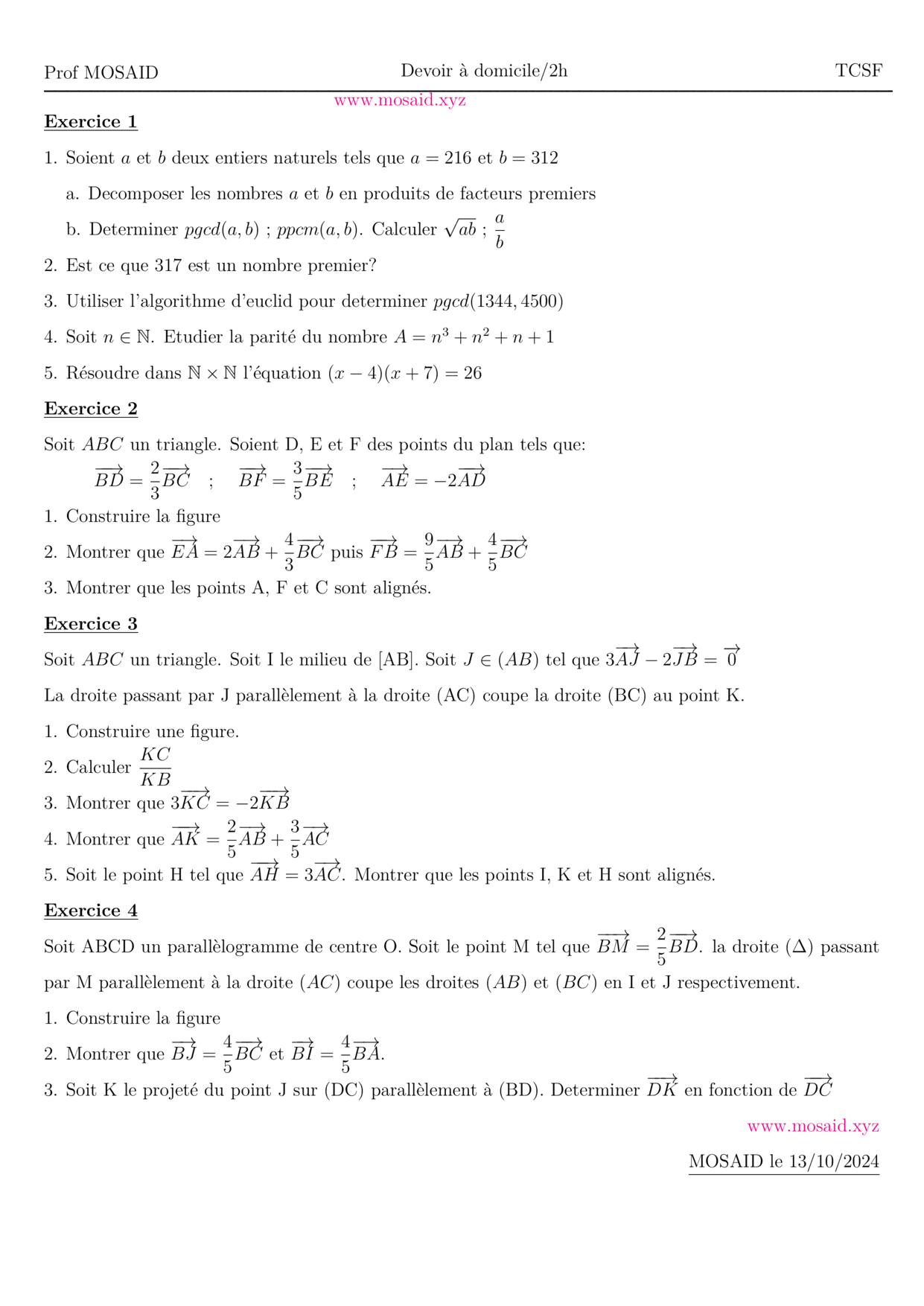
Solution — DM 1 - Arithmetiques, Calcul vectoriel et projection
27 Oct 2026 • 1 views
حل • Maths • Tronc Commun Sciences
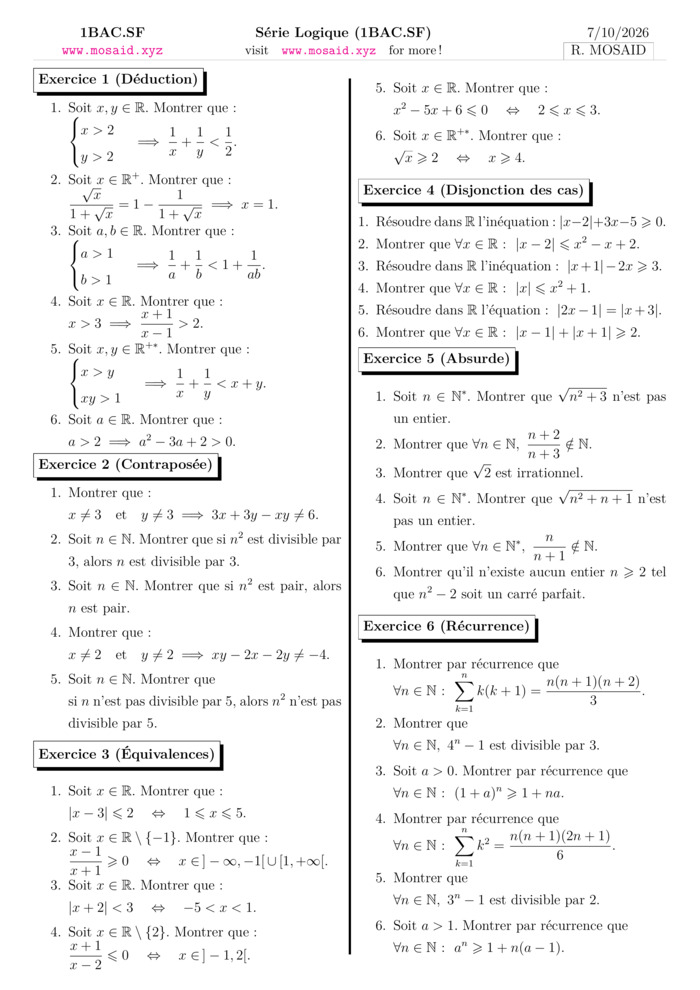
BACCALAURÉAT INTERNATIONAL SCIENCES MATHÉMATIQUES, OPTION FRANÇAIS
28 Sep 2026 • 149 views
درس • Maths • 2 Bac Science Maths
الأكثر مشاهدة
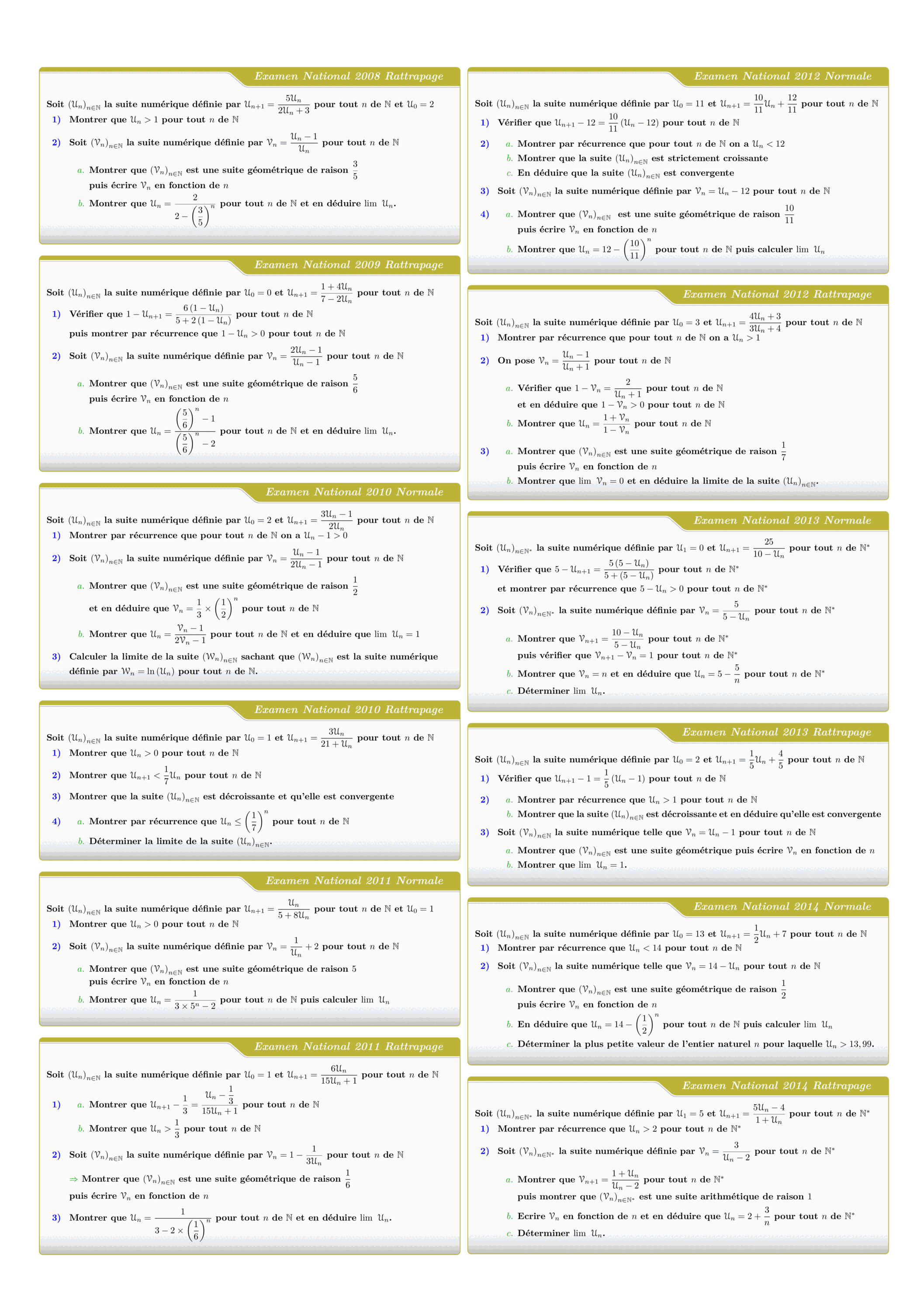
Tous les sujets des suites numériques des examens nationaux 2008 - 2022
views: 3.15K
امتحان • Maths • 2 Bac Science
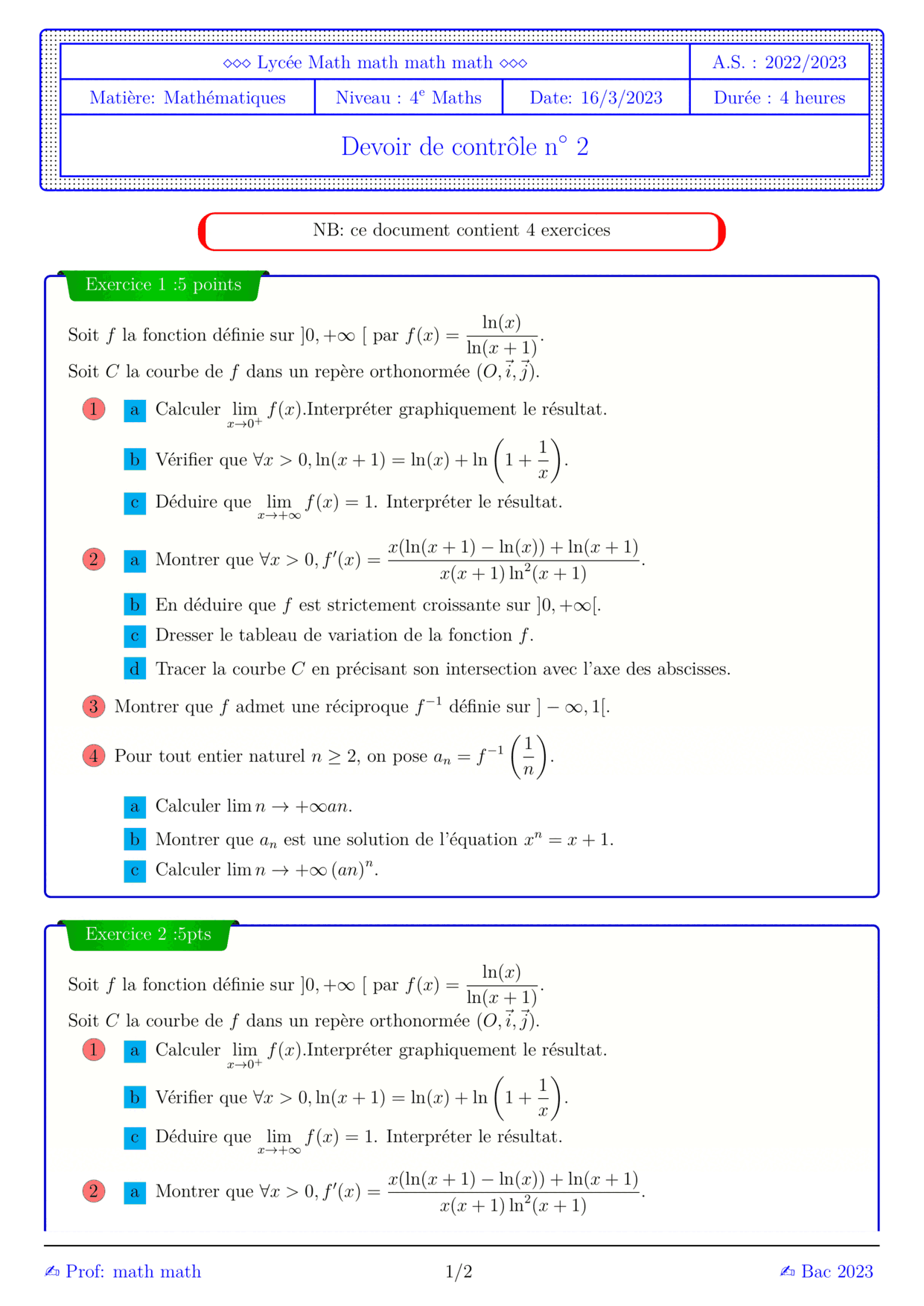

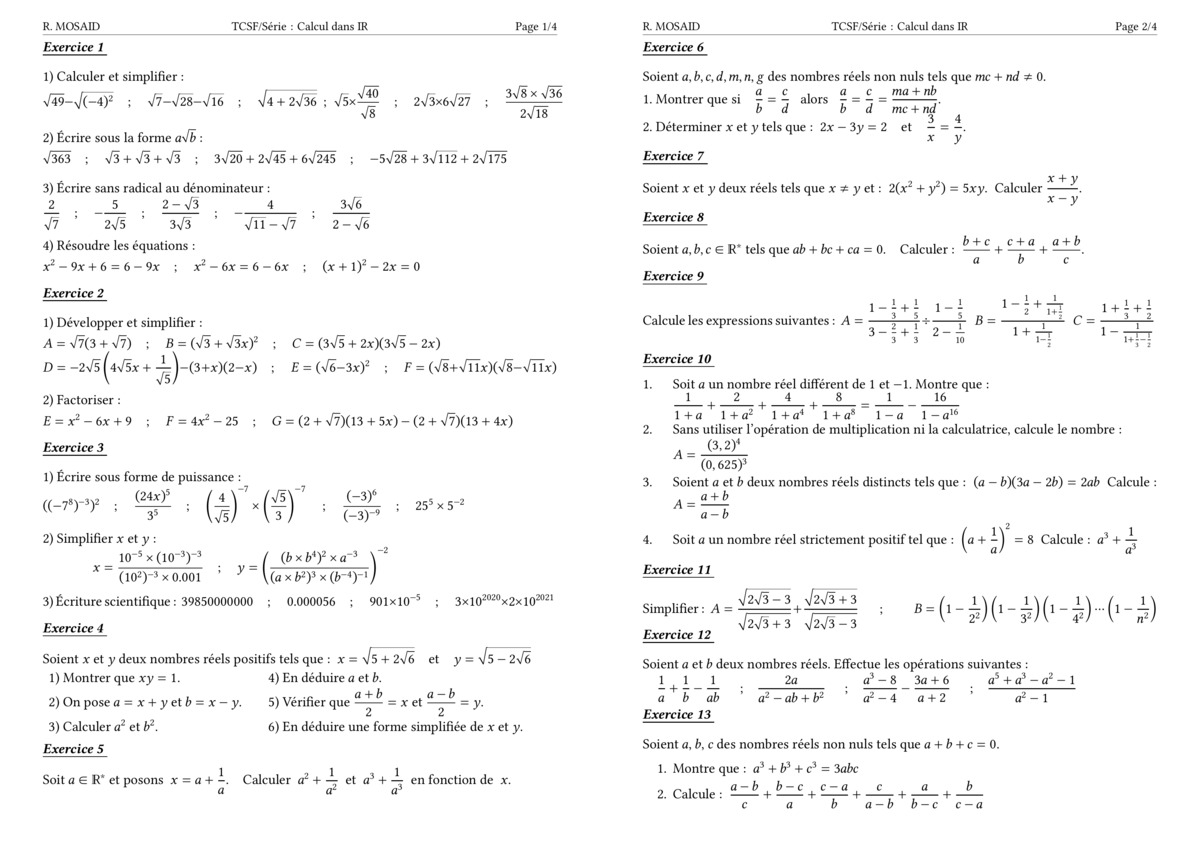
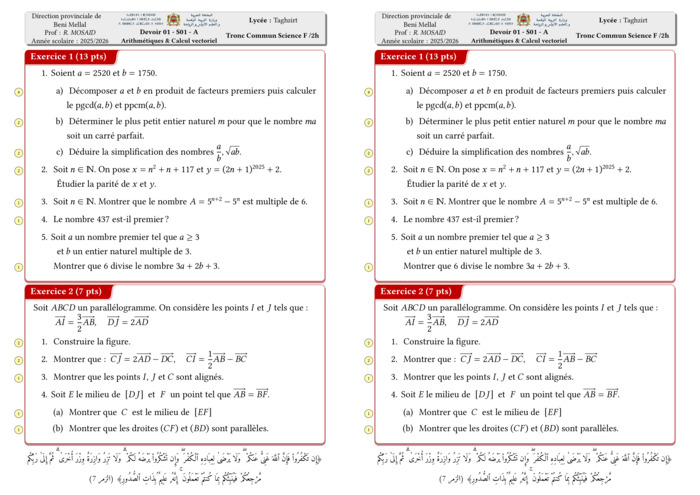
Control 01 S01 En arithmétiques et Calcul vectoriel - A 2025-2026
views: 2.15K
امتحان • Maths • Tronc Commun Sciences
DM 1 - Arithmetiques, Calcul vectoriel et projection
views: 1.99K
امتحان • Maths • Tronc Commun Sciences
MATHEMATIQUES Examens nationaux 2003-2021 2 Bac.Sciences expérimentales
views: 1.98K
امتحان • Maths • 2 Bac Science
Recent Articles



Most Viewed Articles




The Ultimate Vim Setup (My 2024 vimrc ) : Essential Commands, Configurations, and Plugin Tips
Views: 1.49K
12 Apr 2024
Complete Tutorial: Creating Categories and Subcategories Using Pages in Pelican
Views: 1.14K
24 Jun 2025
اترك تعليقًا