Devoir 03, S01
📅 January 01, 2026 | 👁️ Views: 344 | 📝 2 exercises | ❓ 29 questions
📚 Courses Covered in This Exam:
📄 What you'll find on this page:
• The Exam PDF is embedded below — you can read and scroll through it directly without leaving the page.
• A direct download button is available at the bottom for offline access.
• You'll also discover related exams, courses, and exercises tailored to the same subject and level.
• This exam contains 2 exercises and 29 questions.
• The complete LaTeX source code is included below for learning or customization.
• Generated using my LaTeX Exam Generator — a flexible tool for building structured academic documents effortlessly.
• Need your own materials professionally formatted? I offer a LaTeX typesetting service — send me your content and get a clean PDF + source file at a symbolic price.
📄 ماذا ستجد في هذه الصفحة:
• ملف الامتحان بصيغة PDF معروض أدناه — يمكنك تصفحه والاطلاع عليه مباشرة دون الحاجة لتحميله.
• يتوفر زر تحميل مباشر في أسفل الصفحة للاحتفاظ بالملف على جهازك.
• ستجد أيضًا مجموعة من الامتحانات والدروس والتمارين المرتبطة بنفس الدرس لتعزيز فهمك.
• هذا الامتحان يحتوي على 2 تمارين و 29 سؤالاً.
• تم تضمين الكود الكامل بلغة LaTeX أسفل الصفحة لمن يرغب في التعديل عليه أو التعلم منه واستخدامه.
• تم إنشاء هذا المحتوى باستخدام مولد امتحانات LaTeX — أداة قوية تساعدك على إنشاء مستندات تعليمية احترافية بسهولة.
• هل تحتاج تنسيقًا احترافيًا لموادك الخاصة؟ أقدم خدمة كتابة LaTeX — أرسل محتواك واحصل على PDF نظيف وملف مصدر بسعر رمزي.
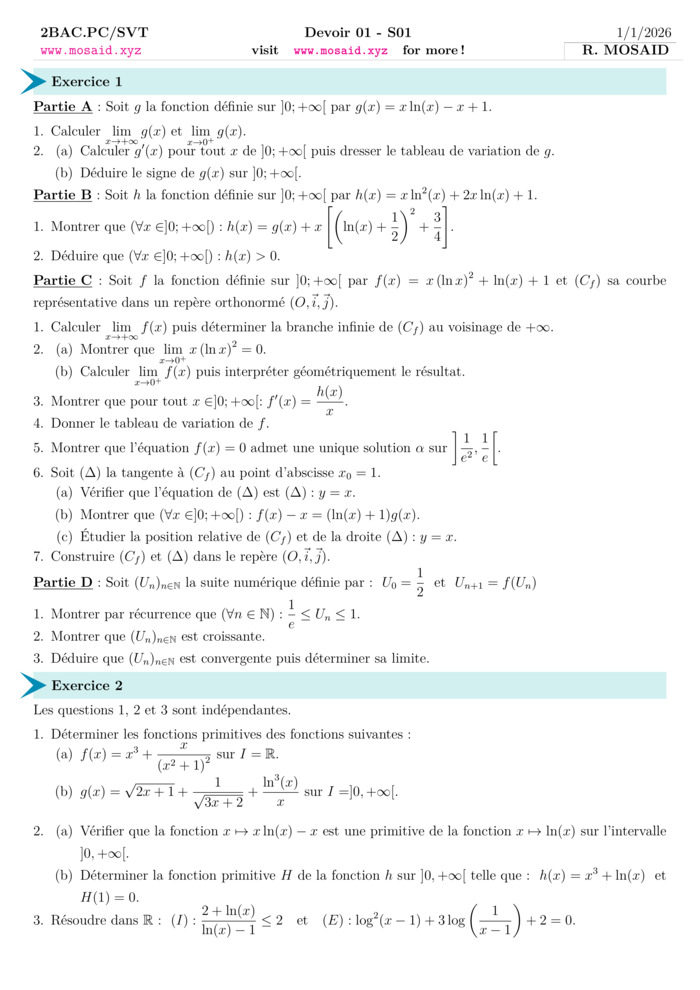
This PDF covers maths exam for 2-bac-science students. It includes 2 exercises and 29 questions. Designed to help you master the topic efficiently.
\documentclass[a4paper,12pt]{article}

\usepackage[left=1.00cm, right=1.00cm, top=2cm, bottom=1.50cm]{geometry}

\usepackage[utf8]{inputenc}
\usepackage{fontspec}
\usepackage{amsmath, amsfonts, amssymb, amsthm}
\usepackage{graphicx}
\usepackage{xcolor}
\usepackage{multicol}
\usepackage{enumitem}
\usepackage{mathrsfs}
\usepackage{colortbl}
\usepackage{varwidth}
\usepackage[most]{tcolorbox}


\tcbuselibrary{skins,breakable}
\usepackage{tikz}
\usetikzlibrary{calc}
\usetikzlibrary{shadows}
\usepackage{tabularx, array}
\usepackage{setspace}
\usepackage{hyperref}
\hypersetup{
    colorlinks=true,
    urlcolor=magenta
}

\usepackage{fancyhdr}

% French language support
\usepackage[french]{babel}


% Two-page layout (conditionally included)


% --- Colors ---
\definecolor{maroon}{cmyk}{0,0.87,0.68,0.32}
\definecolor{pBlue}{RGB}{102, 53, 153}

\definecolor{myblue}{HTML}{1D2A6E}
\definecolor{myred}{HTML}{A97E77}
\definecolor{mybrown}{HTML}{B35823}
\definecolor{gold}{HTML}{B48920}
\definecolor{myorange}{HTML}{ED8C2B}
\definecolor{col}{RGB}{45, 136, 119}
\definecolor{MainRed}{rgb}{.8, .1, .1}
\definecolor{winered}{rgb}{0.5,0,0}
\definecolor{JungleGreen}{HTML}{29AB87}

\definecolor{myblue3}{RGB}{36, 57, 126}
\definecolor{mygray}{RGB}{112,121,139}
\definecolor{LemonGlacier}{RGB}{253,255,0}
\colorlet{myblue3}{red!75!black}

\definecolor{lightgray}{gray}{0.6}
\definecolor{arrowblue}{RGB}{0,140,180}
\definecolor{bannerblue}{RGB}{210,240,240}

% --- Basic Settings ---
% Language variables for French exams
\def\professor{R. MOSAID}  % Should be R. MOSAID not {{R. MOSAID}}
\def\classname{2BAC.PC/SVT}
\def\examtitle{Devoir 01 - S01}
\def\schoolname{Lycée : Taghzirt}
\def\academicyear{2025/2026}
\def\subject{Mathématiques}
\def\duration{2h}
\def\secondtitle{\small{visit ~~\wsite~~ for more!}}
\def\province{Direction provinciale\newline de Beni Mellal}
\def\logo{\includegraphics[width=\linewidth]{images/logo-men.png}}
\def\wsite{\href{https://www.mosaid.xyz}{\textcolor{magenta}{\texttt{www.mosaid.xyz}}}}
\def\ddate{\hfill \number\day/\number\month/\number\year~~}


% Exam-specific settings and custom definitions
% This file is generated in the current working directory
% Edit this file to customize your exam settings


% Define column type for centered cells
\newcolumntype{Y}{>{\centering\arraybackslash}X}
\newcolumntype{M}[1]{@{}>{\centering\arraybackslash}m{\#1}@{}}

\newcommand{\tb}{\tikz[baseline=-0.6ex]{\fill (0,0) circle (2pt);}~}

\newcommand{\ccc}[1]{
    \begin{tikzpicture}[overlay, remember picture]
        \node[circle, inner sep=3pt, draw=black, outer sep=0pt] at (0.5,0.2) {\#1};
    \end{tikzpicture}
}


\newcommand{\circled}[1]{%
  \tikz[baseline=(char.base)]{
    \node[shape=circle,draw,inner sep=1pt, font=\bf] (char) {\#1};}%
}


% Document spacing
\setstretch{1.3}

% Math display style
\everymath{\displaystyle}

%\mathversion{bold}

%\AtBeginDocument{\fontsize{15}{17}\selectfont}

%\newcommand{\fff}[1]{\makebox[#1cm]{\dotfill}}

\newcommand{\dfp}[1]{\dotfill (\bf{\#1 pt})}

\SetEnumitemKey{tight}{
    leftmargin=*,
    itemsep=0pt,
    topsep=0pt,
    parsep=0pt,
    partopsep=0pt,
    before=\vspace{-2pt},   % reduce space before
    after=\vspace{-2pt}     % reduce space after
}

\newcommand{\VMargin}[1]{%
  \begin{tikzpicture}[remember picture,overlay]
    \draw[line width=1pt]
      ([xshift=#1]current page.north west) --
      ([xshift=#1]current page.south west);
  \end{tikzpicture}%
}


% Custom theorem environments (uncomment if needed)
% \newtheorem{theorem}{Theorem}
% \newtheorem{lemma}{Lemma}
% \newtheorem{corollary}{Corollary}

% Custom exercise environments (uncomment if needed)
% \newenvironment{solution}{\begin{proof}[Solution]}{\end{proof}}
% \newenvironment{remark}{\begin{proof}[Remark]}{\end{proof}}

% Custom commands for this exam (add your own below)
% \newcommand{\answerline}[1]{\underline{\hspace{\#1}}}
% \newcommand{\points}[1]{\hfill(\mbox{\#1 points})}

% Additional packages (uncomment if needed)
% \usepackage{siunitx} % For SI units
% \usepackage{chemformula} % For chemical formulas
% \usepackage{circuitikz} % For circuit diagrams

% Page layout adjustments
% \setlength{\parindent}{0pt}
% \setlength{\parskip}{1em}

% Custom colors for this exam
% \definecolor{myblue}{RGB}{0,100,200}
% \definecolor{mygreen}{RGB}{0,150,0}

% ----------------------------------------------------------------------
% ADD YOUR CUSTOM DEFINITIONS BELOW THIS LINE
% ----------------------------------------------------------------------

% Example:
\newcommand{\dif}{\mathrm{d}}
\newcommand{\R}{\mathbb{R}}
\newcommand{\N}{\mathbb{N}}
\newcommand{\Z}{\mathbb{Z}}
\newcommand{\Q}{\mathbb{Q}}
\newcommand{\C}{\mathbb{C}}
% --- Theme 11: Chevron arrow banner (as in scanned sheet) ---
\definecolor{arrowblue}{RGB}{0,140,180}
\definecolor{bannerblue}{RGB}{210,240,240}

\newtcolorbox{exothemeeleven}[2][]{%
  enhanced,
  breakable,
  width=\linewidth,
  colback=white,
  colframe=white,
  boxrule=0pt,
  left=0pt, right=0pt, top=5pt, bottom=0pt,
  boxsep=0pt,
  before skip=5pt, after skip=5pt,
  interior style={fill=none, top color=white, bottom color=white},
  title={\#2},
  boxed title style={empty, boxrule=0pt, top=0pt, bottom=0pt},
  attach boxed title to top left={yshift=0pt},
  varwidth boxed title=0.9\linewidth,
  before upper={\parskip=4pt},
  overlay unbroken={
    % Chevron banner background
    \begin{scope}[shift={(frame.north west)}]
      \fill[bannerblue] (0,0) rectangle (\linewidth,0.8);
      \fill[arrowblue] (-0.4,0) -- (0.4,0.4) -- (-0.4,0.8) -- (0,0.4) -- cycle;
      \node[anchor=west, font=\bfseries] at (0.4,0.4)
        {\tcbtitletext};
    \end{scope}
  },
  #1
}


\newcommand{\printexo}[3]{%
  \if\relax\detokenize{\#2}\relax
    \def\fulltitle{Exercice #1}%
  \else
    \def\fulltitle{Exercice #1~#2}%
  \fi
  \begin{exothemeeleven}{\fulltitle}#3\end{exothemeeleven}%
  \vspace{0.2cm}%
}

% --- Header Style 9 (fr) ---
\newcommand{\printheadnine}{%
  \arrayrulecolor{lightgray}
  \begin{tabular}{m{0.22\textwidth} m{0.52\textwidth} m{0.22\textwidth}}
      \textbf{\classname} & \centering \textbf{\examtitle}
      & \ddate \\
      \wsite & \centering \large\textbf{\secondtitle}
      &\hfill
        \begin{tabular}{|c}
          \hline
          \textbf{~~\professor}
        \end{tabular}\\
      \hline
  \end{tabular}
  \arrayrulecolor{black}
}

\fancyhf{}
\renewcommand{\headrulewidth}{0pt}
\renewcommand{\footrulewidth}{0pt}
\setlength{\headheight}{47pt}
\setlength{\headsep}{0pt}
\fancyhead[C]{%
  \printheadnine
}%
\pagestyle{fancy}

\begin{document}


% Exercise 1 (originally 1)
\printexo{1}{}{
\noindent\textbf{\underline{Partie A}}:
Soit \( g \) la fonction définie sur \( ]0; +\infty[ \) par \( g(x) = x \ln(x) - x + 1 \).
\begin{enumerate}[tight]
    \item Calculer \( \lim_{x \to +\infty} g(x) \) et \( \lim_{x \to 0^+} g(x) \).
    \item
    \begin{enumerate}[tight]
        \item Calculer \( g'(x) \) pour tout \( x \) de \( ]0; +\infty[ \) puis dresser le tableau de variation de \( g \).
        \item Déduire le signe de \( g(x) \) sur \( ]0; +\infty[ \).
    \end{enumerate}
\end{enumerate}
\noindent\textbf{\underline{Partie B}}:
Soit \( h \) la fonction définie sur \( ]0; +\infty[ \) par \( h(x) = x \ln^2(x) + 2x \ln(x) + 1 \).
\begin{enumerate}[tight]
    \item Montrer que \( (\forall x \in ]0; +\infty[ ) : h(x) = g(x) + x \left[ \left( \ln(x) + \frac{1}{2} \right)^2 + \frac{3}{4} \right] \).
    \item Déduire que \( (\forall x \in ]0; +\infty[ ) : h(x) > 0 \).
\end{enumerate}
\noindent\textbf{\underline{Partie C}}:
Soit \( f \) la fonction définie sur \( ]0; +\infty[ \) par \( f(x) = x \left( \ln x \right)^2 + \ln(x) + 1 \) et \( (C_f) \) sa courbe représentative dans un repère orthonormé \( (O, \vec{i}, \vec{j}) \).

\begin{enumerate}[tight]
    \item Calculer \( \lim_{x \to +\infty} f(x) \) puis déterminer la branche infinie de \( (C_f) \) au voisinage de \( +\infty \).
    \item
    \begin{enumerate}[tight]
        \item Montrer que \( \lim_{x \to 0^+} x \left( \ln x \right)^2 = 0 \).
        \item Calculer \( \lim_{x \to 0^+} f(x) \) puis interpréter géométriquement le résultat.
    \end{enumerate}
    \item Montrer que pour tout \( x \in ]0; +\infty[ : f'(x) = \frac{h(x)}{x} \).
    \item Donner le tableau de variation de \( f \).
    \item Montrer que l’équation \( f(x) = 0 \) admet une unique solution \( \alpha \) sur \( \left] \frac{1}{e^2}, \frac{1}{e} \right[ \).
    \item Soit \( (\Delta) \) la tangente à \( (C_f) \) au point d’abscisse \( x_0 = 1 \).
    \begin{enumerate}[tight]
        \item Vérifier que l’équation de \( (\Delta) \) est \( (\Delta) : y = x \).
        \item Montrer que \( (\forall x \in ]0; +\infty[ ) : f(x) - x = (\ln(x) + 1)g(x) \).
        \item Étudier la position relative de \( (C_f) \) et de la droite \( (\Delta) : y = x \).
    \end{enumerate}
    \item Construire \( (C_f) \) et \( (\Delta) \) dans le repère \( (O, \vec{i}, \vec{j}) \).
\end{enumerate}
\noindent\textbf{\underline{Partie D}}:
Soit \( (U_n)_{n \in \mathbb{N}} \) la suite numérique définie par :
~$U_0=\frac{1}{2}$~ et ~$U_{n+1}=f(U_n)$~
\begin{enumerate}[tight]
    \item Montrer par récurrence que \( (\forall n \in \mathbb{N}) : \frac{1}{e} \leq U_n \leq 1 \).
    \item Montrer que \( (U_n)_{n \in \mathbb{N}} \) est croissante.
    \item Déduire que \( (U_n)_{n \in \mathbb{N}} \) est convergente puis déterminer sa limite.
\end{enumerate}
}

% Exercise 2 (originally 2)
\printexo{2}{}{
Les questions 1, 2 et 3 sont indépendantes.
\begin{enumerate}[tight]
    \item Déterminer les fonctions primitives des fonctions suivantes :
    \begin{enumerate}[tight]
        \item \( f(x) = x^3 + \frac{x}{\left( x^2 + 1 \right)^2} \) sur \( I = \mathbb{R} \).
        \item \( g(x) = \sqrt{2x + 1} + \frac{1}{\sqrt{3x + 2}} + \frac{\ln^3(x)}{x} \) sur \( I = ]0, +\infty[ \).\\
    \end{enumerate}
    \item
    \begin{enumerate}[tight]
        \item Vérifier que la fonction \( x \mapsto x \ln(x) - x \) est une primitive de la fonction \( x \mapsto \ln(x) \) sur l’intervalle \( ]0, +\infty[ \).
        \item Déterminer la fonction primitive \( H \) de la fonction \( h \) sur \( ]0, +\infty[ \) telle que :
        ~\(
        h(x) = x^3 + \ln(x)
        \)~
        et \( H(1) = 0 \).
    \end{enumerate}
    \item Résoudre dans \( \mathbb{R} \) :
    ~\(
    (I) : \frac{2 + \ln(x)}{\ln(x) - 1} \leq 2 \quad \text{et} \quad (E) : \log^2(x - 1) + 3 \log\left(\frac{1}{x - 1}\right) + 2 = 0.
    \)~
\end{enumerate}
}


\end{document}
✨ Get your own materials formatted with LaTeX
Explore more maths content for 2-bac-science:
Related Courses, Exams, and Exercises
Frequently Asked Questions
What chapters or courses does this exam cover?
This exam covers: اشتقاق دالة عددية و دراسة الدوال, نهاية متتالية عددية, الدوال الأصلية, الدوال اللوغاريتمية. It is designed to test understanding of these topics.
How many questions are in this exam?
The exam contains approximately 29 questions.
Is this exam aligned with the official curriculum?
Yes, it follows the 2-bac-science maths guidelines.
What topics are covered in this course?
The course "Fonctions Primitives" covers key concepts of maths for 2-bac-science. Designed to help students master the curriculum.
Is this course suitable for beginners?
Yes, the material is structured to be accessible while providing depth for advanced learners.
Are there exercises or practice problems?
This resource includes 2 exercise(s) to reinforce learning.
Does this course include solutions?
Solutions are available separately.
Download maths Exam PDF (2-bac-science)
📄 Need LaTeX formatting?
Send me your homework, exam, or exercise content and I’ll turn it into a professional PDF.
Learn more →Recent Courses
BACCALAURÉAT INTERNATIONAL SCIENCES MATHÉMATIQUES, OPTION FRANÇAIS
28 Sep 2026, 99 views
Course • Maths • 2 Bac Science Maths
Terminal SE - Mathèmatiques: Cours et exercices
27 Sep 2026, 242 views
Course • Maths • 2 Bac Science
Most Viewed Courses
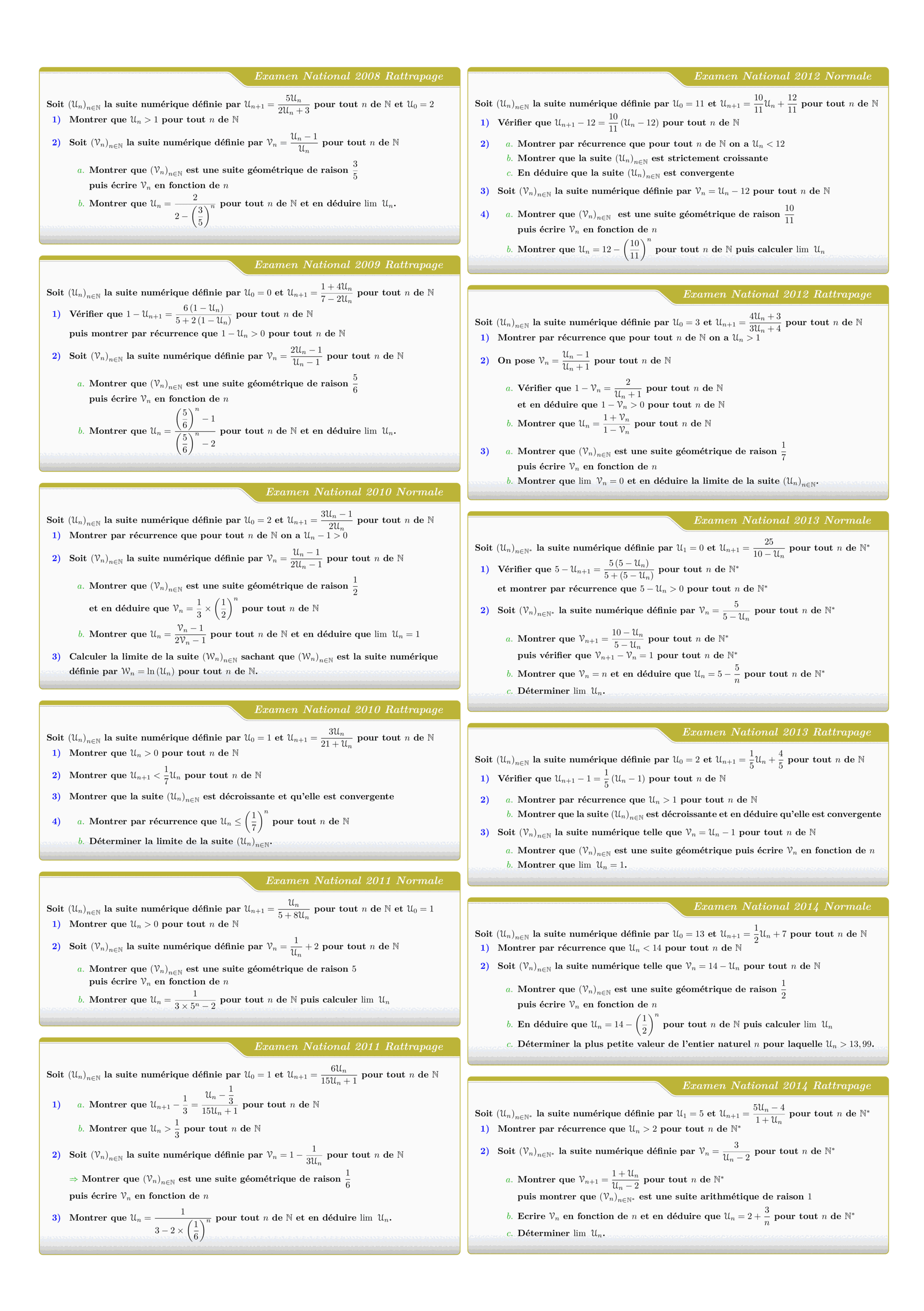
Tous les sujets des suites numériques des examens nationaux 2008 - 2022
Views: 3.11K
Exam • Maths • 2 Bac Science
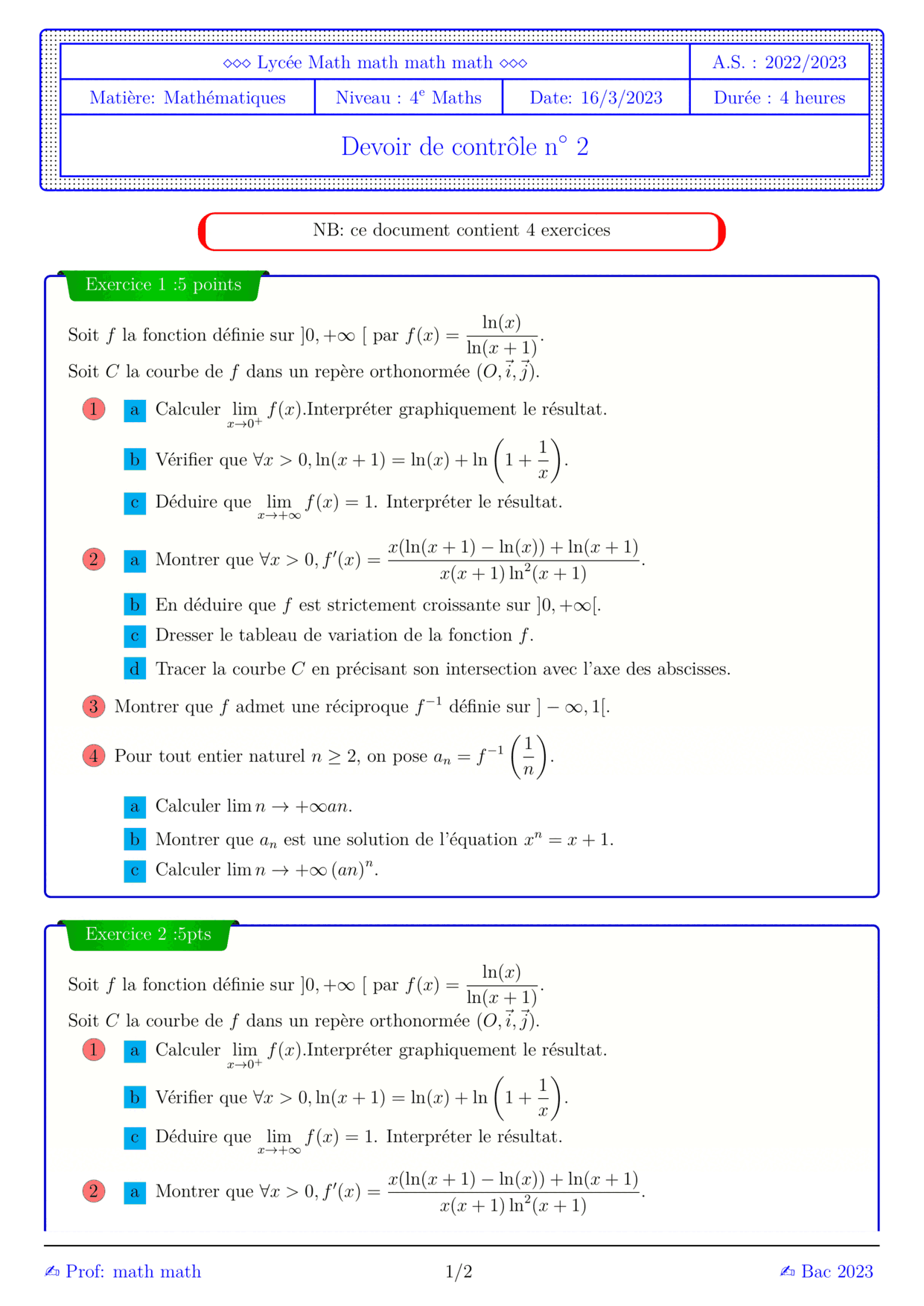

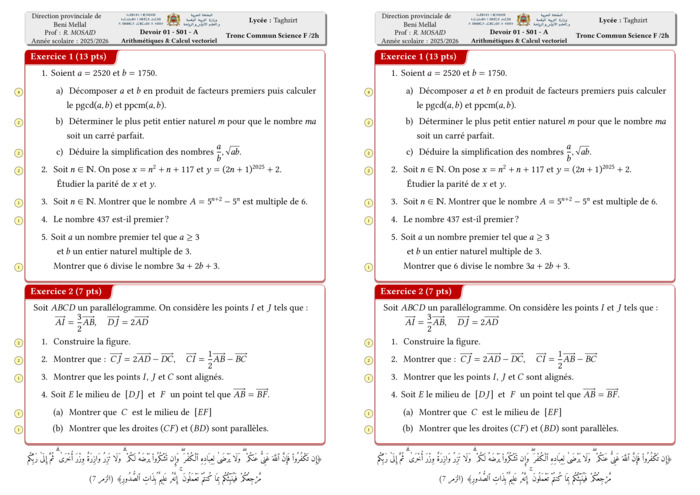
Control 01 S01 En arithmétiques et Calcul vectoriel - A 2025-2026
Views: 2.06K
Exam • Maths • Tronc Commun Sciences
MATHEMATIQUES Examens nationaux 2003-2021 2 Bac.Sciences expérimentales
Views: 1.97K
Exam • Maths • 2 Bac Science
DM 1 - Arithmetiques, Calcul vectoriel et projection
Views: 1.92K
Exam • Maths • Tronc Commun Sciences
Recent Articles


Most Viewed Articles




The Ultimate Vim Setup (My 2024 vimrc ) : Essential Commands, Configurations, and Plugin Tips
Views: 1.46K
12 Apr 2024
Complete Tutorial: Creating Categories and Subcategories Using Pages in Pelican
Views: 1.11K
24 Jun 2025
Leave a comment