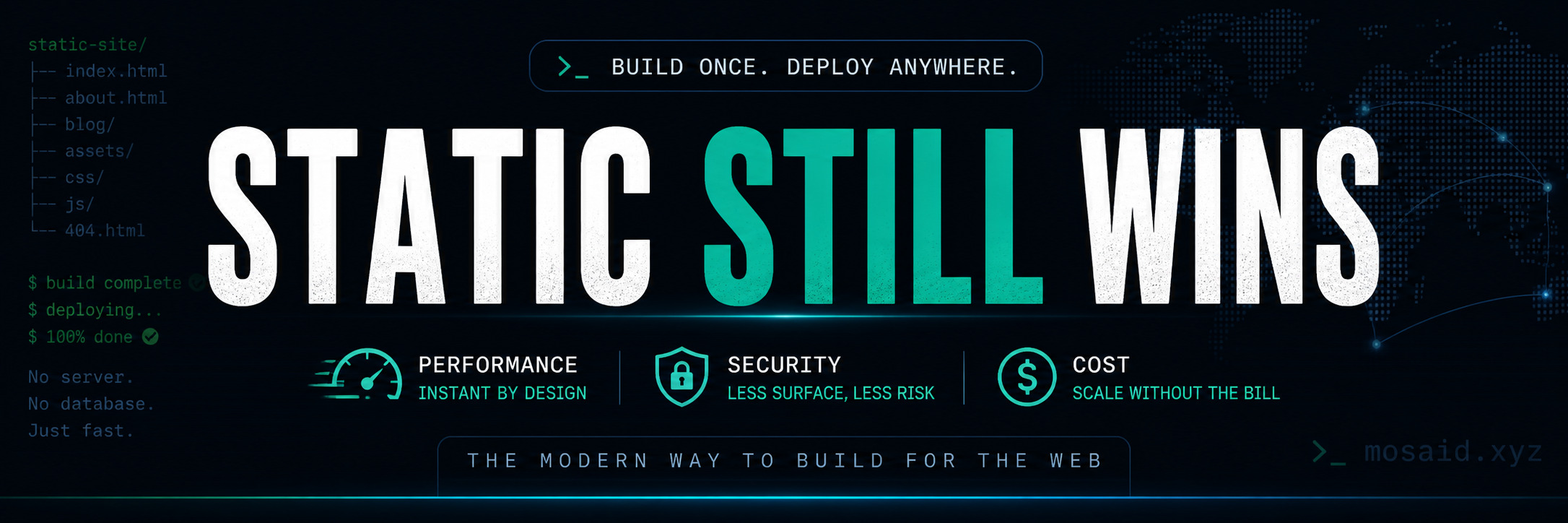
Why Static Websites Still Win in 2026
For the past decade, the web has been obsessed with complexity.
We moved from simple server-rendered pages… to heavy client-side frameworks… to hybrid systems trying to fix the problems they introduced in the first place.
And somewhere along the way, a quiet question started to resurface:
What if most of this isn’t necessary?
This is where static websites come back—not as a nostalgic choice, but as a deliberate engineering decision.
In this article, I’ll show you why static sites still win in 2026—and why they’re the foundation for everything we’re going to build in this series.
•Prefer video? Watch the full explanation:
The Pendulum Always Swings
The web has gone through clear phases:
•Early Web: Pure HTML, simple, fast, but limited.
•Dynamic Era: PHP, databases, server-side rendering everywhere.
•SPA Boom: React, Vue, Angular—everything moved to the browser.
•Modern Hybrid: SSR + hydration + edge rendering (trying to balance performance and flexibility).
Each step solved problems… and introduced new ones.
Now we’re seeing a correction:
Static sites, but smarter.
Not just HTML files—but precomputed systems that deliver speed without sacrificing modern UX.
Performance: Static Is Still King
Let’s strip everything down to what matters: how fast your site loads.
A static site:
• Requires no server processing
• Has no database queries
• Delivers prebuilt HTML directly from a CDN
That means:
•Time To First Byte (TTFB): almost instant
•Rendering: immediate—no hydration delay
•Consistency: same performance globally via CDN
Compare that to a typical modern stack:
• Server-side rendering → compute cost + latency
• Client-side hydration → JavaScript execution delay
• API calls → additional round trips
Even with optimizations, you’re fighting complexity.
With static?
You start fast by design.
Simplicity Is a Feature
Most modern stacks require:
• A backend (Node, Python, etc.)
• A database
• Deployment pipelines
• Environment management
A static site removes almost all of that.
•No backend: just files
•No database: content is your data
•No runtime: everything is prebuilt
You can deploy a static site to:
• A CDN
• Object storage
• Even a simple file server
Scaling becomes trivial because there’s nothing to scale.
No servers. No processes. No surprises.
Security: The Overlooked Advantage
Security is rarely discussed in frontend conversations—but it should be.
A dynamic site exposes:
• Server-side code execution
• Database access
• Authentication systems
• API endpoints
Every one of these is a potential attack surface.
A static site?
•No server logic
•No database
•No injection vectors
You’re essentially serving immutable files.
That drastically reduces risk.
Cost: Almost Zero
Let’s talk money.
A typical dynamic setup might involve:
• Hosting (VPS or managed platform)
• Database costs
• Scaling costs under load
A static site:
• Can be hosted for free on many platforms
• Uses CDN bandwidth (cheap or free tiers)
• Has no runtime compute cost
You can handle thousands—or millions—of requests without touching your infrastructure.
You pay almost nothing for massive scale.
“But Static Sites Are Limited…”
This is the usual objection.
And it’s not wrong.
Out of the box, static sites don’t give you:
• Comments
• Search
• Real-time filtering
• User interaction
That’s why most developers jump straight to frameworks.
But here’s the key idea:
You don’t need a backend for most of these features.
You need:
• Smart precomputation
• Client-side enhancements
• Lightweight integrations
In other words:
Static doesn’t mean limited—it means intentional.
What We’re Building in This Series
This series is not about “basic Pelican tutorials.”
We’re going to build a site that:
• Loads instantly
• Has instant search (no backend)
• Supports dynamic filtering
• Includes comments
• Feels like a modern app
But under the hood?
It’s still static.
No heavy frameworks. No unnecessary complexity.
Just smart engineering.
What’s Next
In the next article, we’ll break down exactly what you “lose” with static sites—and how we’re going to rebuild those features step by step.
After that, we’ll start building the foundation using Pelican, but with a developer-first approach—not beginner boilerplate.
If you’re used to modern frameworks, this might feel different at first.
But once it clicks, you’ll start seeing the web in a completely different way.
This is where we stop chasing complexity—and start removing it.
•Prefer video? Watch the full explanation:
Recent Articles






Most Viewed Articles





The Ultimate Vim Setup (My 2024 vimrc ) : Essential Commands, Configurations, and Plugin Tips
Views: 1.46K
12 Apr 2024

Complete Tutorial: Creating Categories and Subcategories Using Pages in Pelican
Views: 1.11K
24 Jun 2025
Leave a comment