Fonctions Logarithmes
📅 January 04, 2026 | 👁️ Views: 356
📄 What you'll find on this page:
• The Course PDF is embedded below — you can read and scroll through it directly without leaving the page.
• A direct download button is available at the bottom for offline access.
• You'll also discover related exams, courses, and exercises tailored to the same subject and level.
• The complete LaTeX source code is included below for learning or customization.
• Need your own materials professionally formatted? I offer a LaTeX typesetting service — send me your content and get a clean PDF + source file at a symbolic price.
📄 ماذا ستجد في هذه الصفحة:
• ملف الدرس بصيغة PDF معروض أدناه — يمكنك تصفحه والاطلاع عليه مباشرة دون الحاجة لتحميله.
• يتوفر زر تحميل مباشر في أسفل الصفحة للاحتفاظ بالملف على جهازك.
• ستجد أيضًا مجموعة من الامتحانات والدروس والتمارين المرتبطة بنفس الدرس لتعزيز فهمك.
• تم تضمين الكود الكامل بلغة LaTeX أسفل الصفحة لمن يرغب في التعديل عليه أو التعلم منه واستخدامه.
• هل تحتاج تنسيقًا احترافيًا لموادك الخاصة؟ أقدم خدمة كتابة LaTeX — أرسل محتواك واحصل على PDF نظيف وملف مصدر بسعر رمزي.
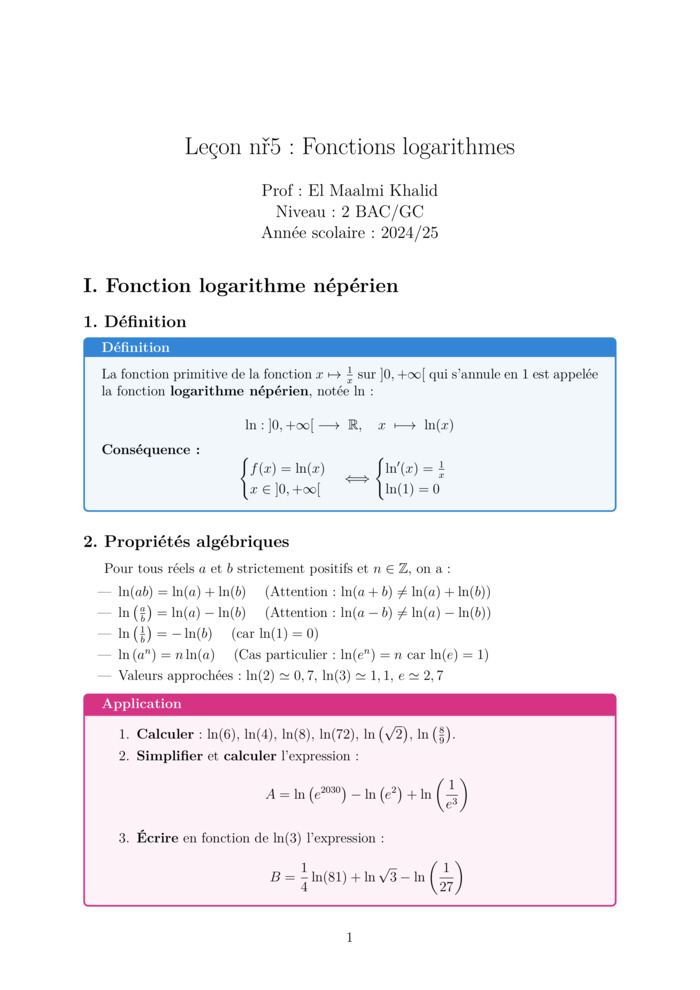
This PDF covers maths course for 2-bac-science students. Designed to help you master the topic efficiently.
ATTENTION : ce cours est extrait d’un fichier Word en utilisant un agent d’IA. Je n’ai pas eu le temps de vérifier le contenu ; des erreurs peuvent subsister. Ce document LaTeX doit être utilisé comme une base de travail pour compléter le cours. Merci de vérifier les informations et de signaler toute incohérence.
\documentclass[12pt]{article}
\usepackage[french]{babel}
\usepackage[utf8]{inputenc}
\usepackage[T1]{fontenc}
\usepackage{amsmath, amssymb, amsthm}
\usepackage{geometry}
\usepackage{tcolorbox}
\usepackage{xcolor}
\usepackage{hyperref}
\usepackage{graphicx}
\usepackage{enumitem}

\geometry{a4paper, margin=2.5cm}

% Définition des couleurs pour les tcolorbox
\definecolor{defcolor}{RGB}{0, 102, 204}
\definecolor{exemplecolor}{RGB}{0, 153, 76}
\definecolor{appcolor}{RGB}{204, 0, 102}
\definecolor{remcolor}{RGB}{255, 128, 0}
\definecolor{theoremcolor}{RGB}{102, 0, 204}

% Styles de tcolorbox
\newtcolorbox{definition}[1][]{
    colback=defcolor!5,
    colframe=defcolor!80,
    fonttitle=\bfseries,
    title=Définition,
    #1
}

\newtcolorbox{exemple}[1][]{
    colback=exemplecolor!5,
    colframe=exemplecolor!80,
    fonttitle=\bfseries,
    title=Exemple,
    #1
}

\newtcolorbox{application}[1][]{
    colback=appcolor!5,
    colframe=appcolor!80,
    fonttitle=\bfseries,
    title=Application,
    #1
}

\newtcolorbox{remarque}[1][]{
    colback=remcolor!5,
    colframe=remcolor!80,
    fonttitle=\bfseries,
    title=Remarque,
    #1
}

\newtcolorbox{theoreme}[1][]{
    colback=theoremcolor!5,
    colframe=theoremcolor!80,
    fonttitle=\bfseries,
    title=Théorème,
    #1
}

\title{Leçon n°5 : Fonctions logarithmes}
\author{Prof : El Maalmi Khalid \\ Niveau : 2 BAC/GC \\ Année scolaire : 2024/25}
\date{}

\begin{document}

\maketitle

\section*{I. Fonction logarithme népérien}

\subsection*{1. Définition}

\begin{definition}
La fonction primitive de la fonction $x \mapsto \frac{1}{x}$ sur $]0, +\infty[$ qui s'annule en $1$ est appelée la fonction \textbf{logarithme népérien}, notée $\ln$ :

\[
\ln : \; ]0, +\infty[ \; \longrightarrow \; \mathbb{R}, \quad x \; \longmapsto \; \ln(x)
\]

\textbf{Conséquence :}
\[
\begin{cases}
f(x) = \ln(x) \\
x \in \; ]0, +\infty[
\end{cases}
\Longleftrightarrow
\begin{cases}
\ln'(x) = \frac{1}{x} \\
\ln(1) = 0
\end{cases}
\]
\end{definition}

\subsection*{2. Propriétés algébriques}

Pour tous réels $a$ et $b$ strictement positifs et $n \in \mathbb{Z}$, on a :

\begin{itemize}
    \item $\ln(ab) = \ln(a) + \ln(b)$ \quad (Attention : $\ln(a+b) \neq \ln(a) + \ln(b)$)
    \item $\ln\left( \frac{a}{b} \right) = \ln(a) - \ln(b)$ \quad (Attention : $\ln(a-b) \neq \ln(a) - \ln(b)$)
    \item $\ln\left( \frac{1}{b} \right) = -\ln(b)$ \quad (car $\ln(1) = 0$)
    \item $\ln\left( a^n \right) = n \ln(a)$ \quad (Cas particulier : $\ln(e^n) = n$ car $\ln(e) = 1$)
    \item Valeurs approchées : $\ln(2) \simeq 0,7$, $\ln(3) \simeq 1,1$, $e \simeq 2,7$
\end{itemize}

\begin{application}
\begin{enumerate}
    \item \textbf{Calculer} : $\ln(6)$, $\ln(4)$, $\ln(8)$, $\ln(72)$, $\ln\left( \sqrt{2} \right)$, $\ln\left( \frac{8}{9} \right)$.
    \item \textbf{Simplifier} et \textbf{calculer} l'expression :
    \[
    A = \ln\left( e^{2030} \right) - \ln\left( e^{2} \right) + \ln\left( \frac{1}{e^{3}} \right)
    \]
    \item \textbf{Écrire} en fonction de $\ln(3)$ l'expression :
    \[
    B = \frac{1}{4}\ln(81) + \ln\sqrt{3} - \ln\left( \frac{1}{27} \right)
    \]
\end{enumerate}
\end{application}

\begin{remarque}
Soient $a$ et $b$ deux réels strictement négatifs (donc $ab > 0$ et $\frac{a}{b} > 0$) :
\[
\ln(ab) = \ln|a| + \ln|b|, \quad
\ln\left( \frac{a}{b} \right) = \ln|a| - \ln|b|, \quad
\ln\left( a^{2n} \right) = 2n \ln|a| \text{ avec } n \in \mathbb{N}
\]
\end{remarque}

\subsection*{3. Équations et inéquations}

Pour tous réels $x$ et $y$ strictement positifs, on a :

\begin{itemize}
    \item $\ln(x) \leq \ln(y) \Longleftrightarrow x \leq y$
    \item $\ln(x) < \ln(y) \Longleftrightarrow x < y$
    \item $\ln(x) = 0 \Longleftrightarrow x = 1$
    \item $\ln(x) = \ln(y) \Longleftrightarrow x = y$
    \item $\ln(x) \geq \ln(y) \Longleftrightarrow x \geq y$
    \item $\ln(x) > \ln(y) \Longleftrightarrow x > y$
\end{itemize}

\begin{exemple}
\begin{enumerate}
    \item \textbf{Déterminer} l'ensemble de définition de la fonction $f$ définie par $f(x) = \ln(2x - 1)$ :
    \[
    D_f = \{ x \in \mathbb{R} \mid 2x - 1 > 0 \} = \{ x \in \mathbb{R} \mid x > \frac{1}{2} \} = \left] \frac{1}{2}, +\infty \right[
    \]
    \item \textbf{Résoudre} l'équation $\ln(2x - 1) = 1$ :
    \[
    \ln(2x - 1) = 1 \Longleftrightarrow \ln(2x - 1) = \ln(e) \Longleftrightarrow 2x - 1 = e \Longleftrightarrow x = \frac{e+1}{2} \in \left] \frac{1}{2}, +\infty \right[
    \]
    Donc $S = \left\{ \frac{e+1}{2} \right\}$.
\end{enumerate}
\end{exemple}

\begin{application}
\textbf{Résoudre} dans $\mathbb{R}$ les équations et inéquations suivantes :
\begin{itemize}
    \item $\ln(x) < 2\ln(3)$
    \item $\ln(x+2) < \ln(-3x+1)$
    \item $1 - \ln(x) \geq 0$
    \item $\ln\left( \frac{x}{2} \right) = \ln(5)$
    \item $\ln(x-2) = \ln(3)$
    \item $\ln(3x) = \ln(x-1)$
    \item $\ln(x-3) = 4$
    \item $\ln(-5x+10) = 2$
\end{itemize}
\end{application}

\subsection*{4. Limites fondamentales}

\begin{theoreme}
\begin{itemize}
    \item $\lim\limits_{x \to 1} \frac{\ln(x)}{x-1} = 1$
    \item $\lim\limits_{x \to 0} \frac{\ln(x+1)}{x} = 1$
    \item $\lim\limits_{x \to 0^+} \ln(x) = -\infty$
    \item $\lim\limits_{x \to 0^+} x \ln(x) = 0$
    \item $\lim\limits_{x \to 0^+} x^n \ln(x) = 0$ (pour $n > 0$)
    \item $\lim\limits_{x \to +\infty} \ln(x) = +\infty$
    \item $\lim\limits_{x \to +\infty} \frac{\ln(x)}{x} = 0$
    \item $\lim\limits_{x \to +\infty} \frac{\ln(x)}{x^n} = 0$ (pour $n > 0$)
\end{itemize}
\end{theoreme}

\begin{exemple}
Calculer les limites suivantes :
\begin{enumerate}
    \item $\lim\limits_{x \to 0^+} \left[ \ln(x) + x^3 \ln(x) \right] = -\infty$ car $\lim\limits_{x \to 0^+} x^3 \ln(x) = 0$ et $\lim\limits_{x \to 0^+} \ln(x) = -\infty$.
    \item $\lim\limits_{x \to +\infty} \left( x - \ln(x) \right)$ : forme indéterminée $\infty - \infty$.
    \[
    \lim\limits_{x \to +\infty} \left( x - \ln(x) \right) = \lim\limits_{x \to +\infty} x \left( 1 - \frac{\ln(x)}{x} \right) = +\infty \quad \text{car } \lim\limits_{x \to +\infty} \frac{\ln(x)}{x} = 0.
    \]
\end{enumerate}
\end{exemple}

\begin{application}
Calculer les limites suivantes :
\begin{enumerate}[label=\alph*)]
    \item $\lim\limits_{x \to 0^+} \left( x - \ln(x) \right)$
    \item $\lim\limits_{x \to +\infty} \left( x^4 - \frac{\ln(x)}{x} \right)$
    \item $\lim\limits_{x \to +\infty} \left( x^2 - \ln(x) \right)$
    \item $\lim\limits_{x \to 0^+} (x-2) \ln(x)$
    \item $\lim\limits_{x \to 0^+} \frac{\ln(x)^2}{x}$
    \item $\lim\limits_{x \to +\infty} \frac{x + \ln(x)}{x}$
    \item $\lim\limits_{x \to 0^+} x \left( 1 + \ln(x) \right)$
\end{enumerate}
\end{application}

\subsection*{5. Étude de la fonction logarithme népérien}

Dans un repère orthonormé $(O, \vec{i}, \vec{j})$, on note $(C_f)$ la courbe représentative de $f : x \mapsto \ln(x)$.

\begin{itemize}
    \item \textbf{Domaine de définition} : $D_f = \; ]0, +\infty[$
    \item \textbf{Tableau de variations} : pour tout $x \in \; ]0, +\infty[$, $f'(x) = \frac{1}{x} > 0$, donc $f$ est strictement croissante.

    \begin{center}
    \begin{tabular}{|c|c|c|}
    \hline
    $x$ & $0$ & $+\infty$ \\
    \hline
    $\ln'(x)$ & & $+$ \\
    \hline
    $\ln(x)$ & $-\infty$ & $+\infty$ \\
    \hline
    \end{tabular}
    \end{center}

    \item \textbf{Asymptote verticale} : $\lim\limits_{x \to 0^+} \ln(x) = -\infty$, donc $(C_f)$ admet l'axe des ordonnées $x=0$ comme asymptote verticale.
    \item \textbf{Branche infinie en $+\infty$} : $\lim\limits_{x \to +\infty} \ln(x) = +\infty$ et $\lim\limits_{x \to +\infty} \frac{\ln(x)}{x} = 0$, donc $(C_f)$ admet une branche parabolique de direction l'axe des abscisses.
    \item \textbf{Tangente au point d'abscisse 1} : $f'(1)=1$, $f(1)=0$, donc l'équation de la tangente est $y = x-1$.
\end{itemize}

\subsection*{6. Dérivée d'une fonction de type $x \mapsto \ln(U(x))$}

\begin{theoreme}
Soit $U$ une fonction dérivable sur un intervalle $I$ telle que $U(x) > 0$ pour tout $x \in I$. La fonction $f : x \mapsto \ln(U(x))$ est dérivable sur $I$ et :
\[
f'(x) = \frac{U'(x)}{U(x)} \quad \text{pour tout } x \in I.
\]
\end{theoreme}

\begin{exemple}
Soit $f$ définie sur $I = \; ]-2,2[$ par $f(x) = \ln(4-x^2)$. Alors :
\[
f'(x) = \frac{(4-x^2)'}{4-x^2} = \frac{-2x}{4-x^2}.
\]
\end{exemple}

\begin{application}
Déterminer les fonctions dérivées des fonctions suivantes sur l'intervalle $I$ indiqué :
\begin{enumerate}
    \item $f(x) = \ln(x^2+5)$, $I = \mathbb{R}$
    \item $f(x) = \ln(4x-8)$, $I = \; ]2, +\infty[$
    \item $f(x) = \ln(9x+18)$, $I = \; ]-2, +\infty[$
    \item $f(x) = \ln(3x^2+6x+5)$, $I = \mathbb{R}$
    \item $f(x) = \ln(4x^2+2x+7)$, $I = \mathbb{R}$
    \item $f(x) = \ln(2x^4+4x^2+1)$, $I = \mathbb{R}$
    \item $f(x) = x^2 \ln(x)$, $I = \; ]0, +\infty[$
    \item $f(x) = x^3 \ln(x) - 5x$, $I = \; ]0, +\infty[$
    \item $f(x) = x \ln(x) + 2x$, $I = \; ]0, +\infty[$
    \item $f(x) = x^2 \ln(x^2)$, $I = \; ]0, +\infty[$
\end{enumerate}
\end{application}

\begin{remarque}
Si $U$ est dérivable sur $I$ avec $U(x) \neq 0$ pour tout $x \in I$, alors la fonction $f : x \mapsto \ln|U(x)|$ est dérivable sur $I$ et :
\[
f'(x) = \frac{U'(x)}{U(x)}.
\]
\end{remarque}

\subsection*{7. Logarithme décimal et logarithme de base $a$}

\begin{definition}
Soit $a > 0$ et $a \neq 1$. La fonction \textbf{logarithme de base $a$} est définie sur $]0, +\infty[$ par :
\[
\log_a : x \longmapsto \frac{\ln(x)}{\ln(a)}.
\]
\end{definition}

\begin{remarque}
Pour tout $a > 0$, $a \neq 1$, on a :
\[
\log_a(a) = 1, \quad \log_a(1) = 0, \quad \log_e(x) = \ln(x).
\]
\end{remarque}

\subsubsection*{Propriétés}
Pour tous $x, y > 0$, $a > 0$ ($a \neq 1$) et $n \in \mathbb{Z}$ :
\begin{itemize}
    \item $\log_a(xy) = \log_a(x) + \log_a(y)$
    \item $\log_a\left( \frac{x}{y} \right) = \log_a(x) - \log_a(y)$
    \item $\log_a\left( \frac{1}{x} \right) = -\log_a(x)$
    \item $\log_a(x^n) = n \log_a(x)$
\end{itemize}

\begin{definition}
La fonction \textbf{logarithme décimal} est le logarithme de base $10$, noté $\log$ :
\[
\log(x) = \frac{\ln(x)}{\ln(10)}.
\]
\end{definition}

\begin{application}
Simplifier les expressions suivantes :
\begin{enumerate}
    \item $A = \log_e(e^3) + \log_2(2^5)$
    \item $B = \log_e(e^7) + \log_3(3^7)$
    \item $C = \log_5(1) + \log_2(4)$
    \item $D = \log_e(e^6) + \log_3(9)$
    \item $E = \log_2(8) + \log_3(3^5)$
    \item $F = \log_5(1) + \log_2(16)$
    \item $G = \log(100) - \log(2025)$
    \item $H = \log(10) - \log\left( \frac{1}{10^5} \right)$
\end{enumerate}
\end{application}

\end{document}
✨ Get your own materials formatted with LaTeX
Explore more maths content for 2-bac-science:
Related Courses, Exams, and Exercises
Frequently Asked Questions
What will I learn by the end of this course?
You will gain a solid understanding of Fonctions Logarithmiques and be able to apply it in exams and real‑world problems.
What topics are covered in this course?
The course "Fonctions Logarithmiques" covers key concepts of maths for 2-bac-science. Designed to help students master the curriculum.
Is this course suitable for beginners?
Yes, the material is structured to be accessible while providing depth for advanced learners.
Are there exercises or practice problems?
Exercises are included to help you practice.
Does this course include solutions?
Solutions are available separately.
Download maths Course PDF (2-bac-science)
📄 Need LaTeX formatting?
Send me your homework, exam, or exercise content and I’ll turn it into a professional PDF.
Learn more →Recent Courses
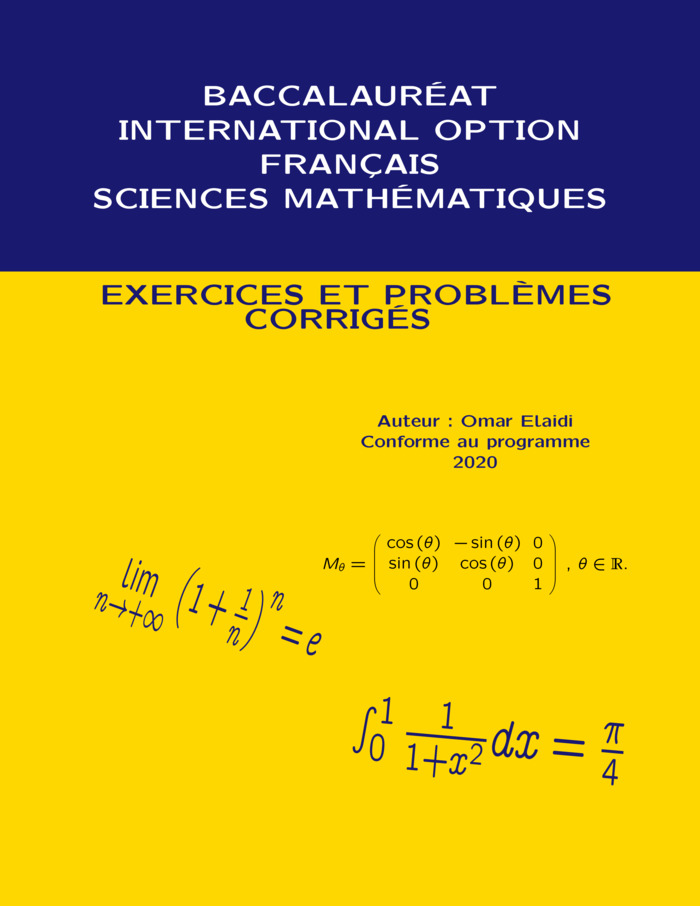
BACCALAURÉAT INTERNATIONAL SCIENCES MATHÉMATIQUES, OPTION FRANÇAIS
28 Sep 2026, 75 views
Course • Maths • 2 Bac Science Maths
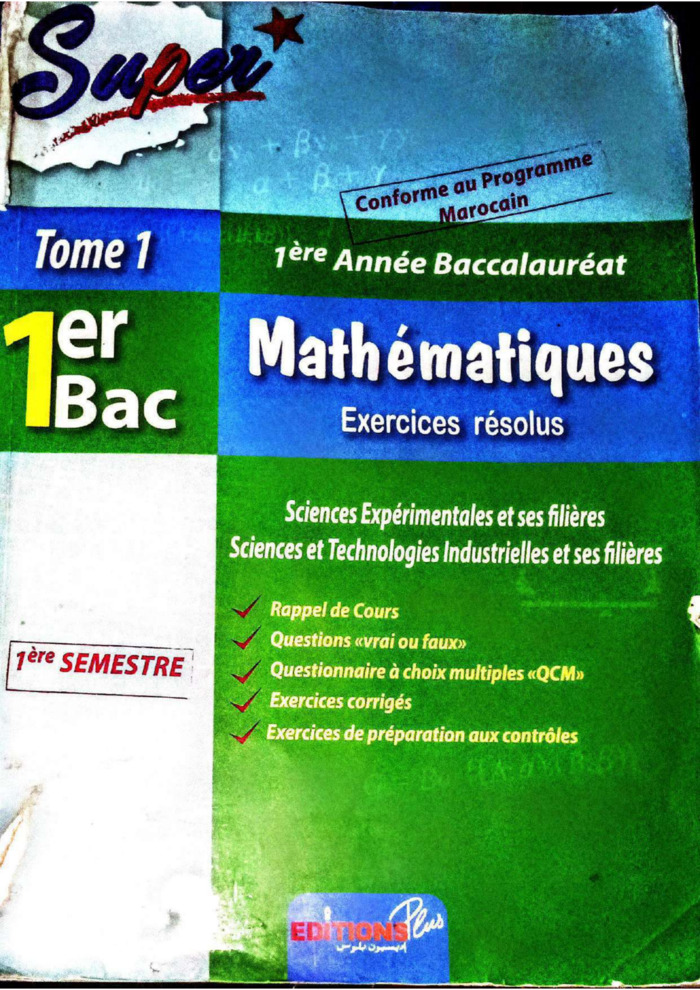
Terminal SE - Mathèmatiques: Cours et exercices
27 Sep 2026, 209 views
Course • Maths • 2 Bac Science

Most Viewed Courses
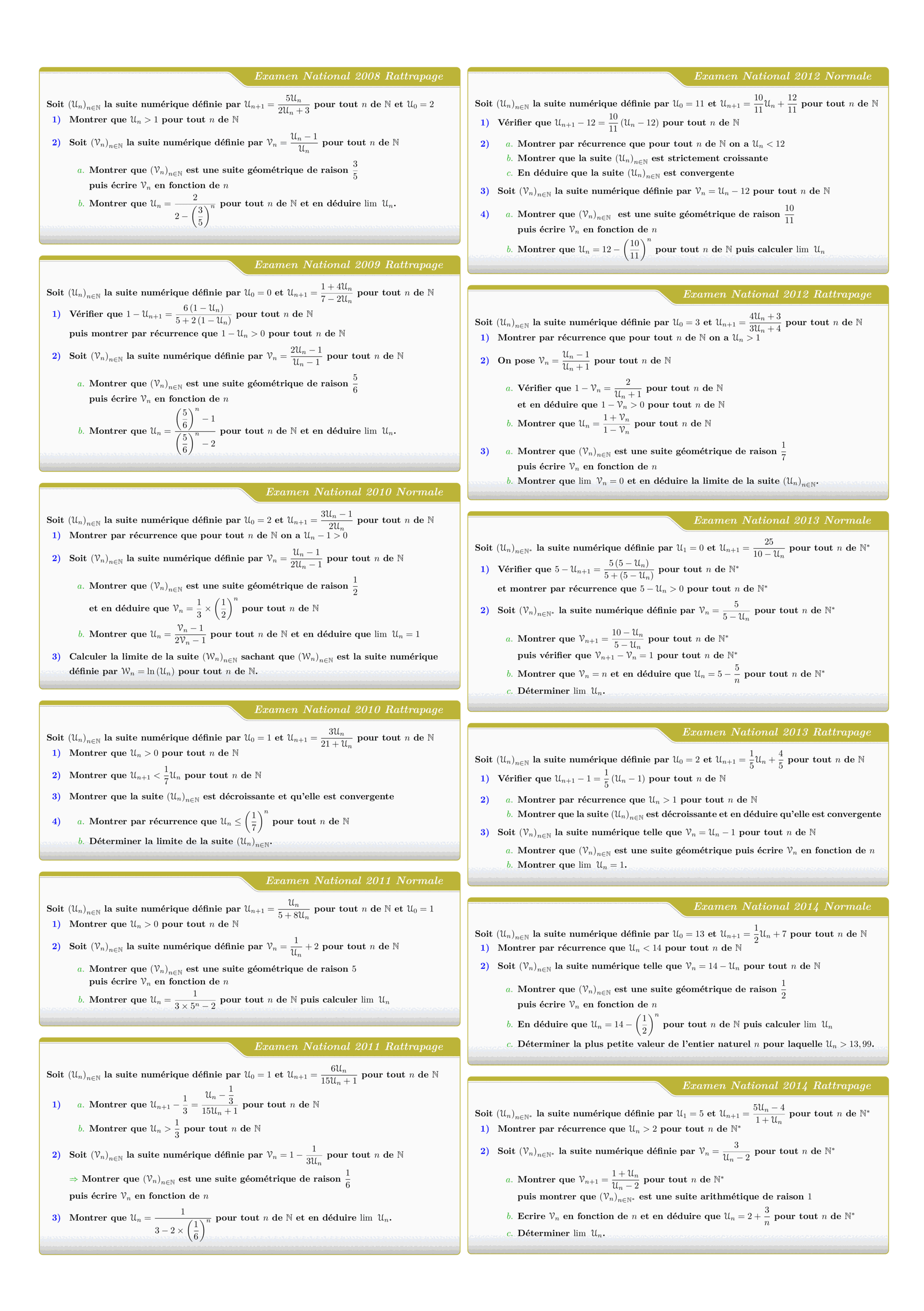
Tous les sujets des suites numériques des examens nationaux 2008 - 2022
Views: 3.10K
Exam • Maths • 2 Bac Science

Control 01 S01 En arithmétiques et Calcul vectoriel - A 2025-2026
Views: 2.04K
Exam • Maths • Tronc Commun Sciences
MATHEMATIQUES Examens nationaux 2003-2021 2 Bac.Sciences expérimentales
Views: 1.96K
Exam • Maths • 2 Bac Science
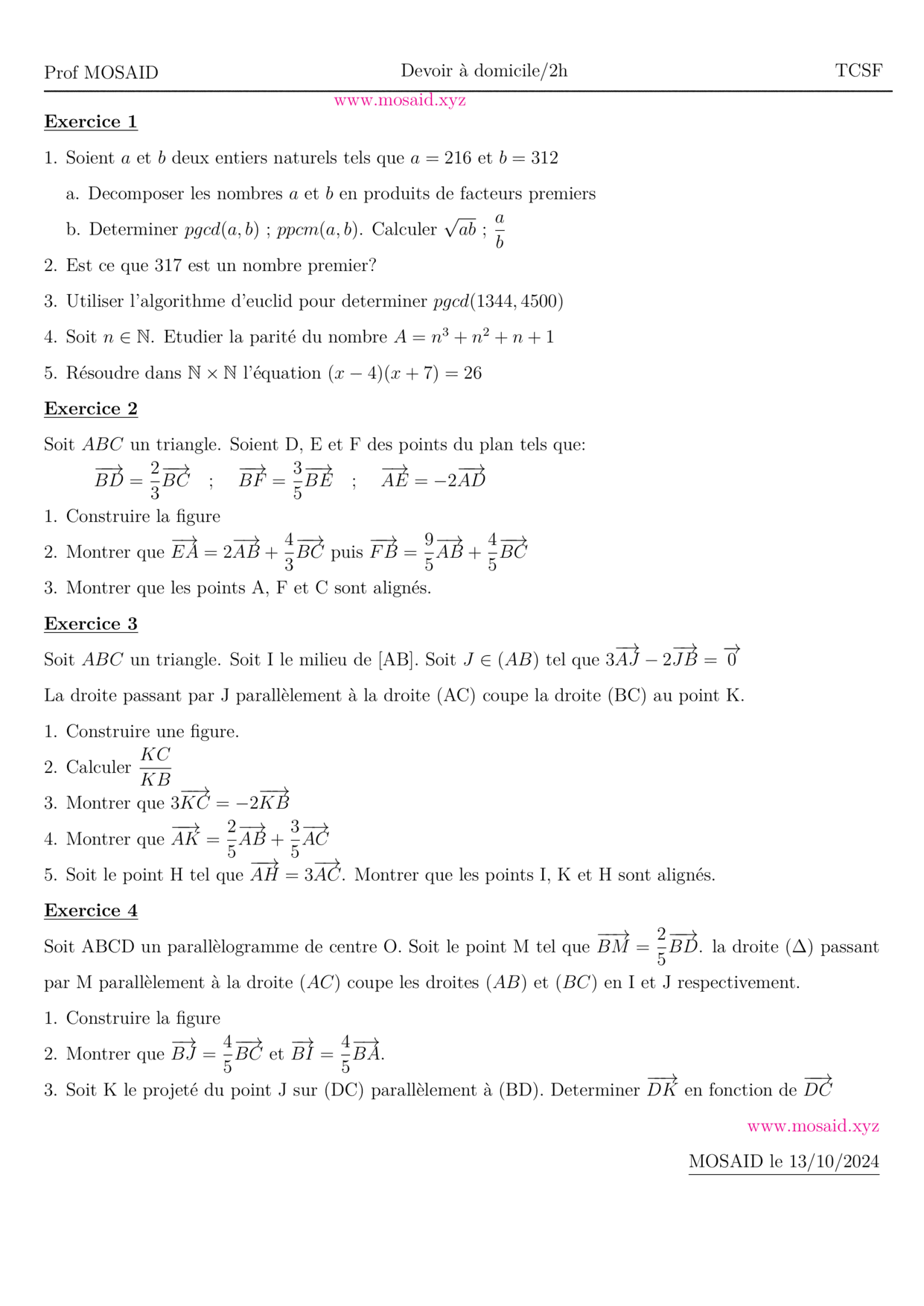
DM 1 - Arithmetiques, Calcul vectoriel et projection
Views: 1.90K
Exam • Maths • Tronc Commun Sciences
Recent Articles







Most Viewed Articles




The Ultimate Vim Setup (My 2024 vimrc ) : Essential Commands, Configurations, and Plugin Tips
Views: 1.45K
12 Apr 2024

Complete Tutorial: Creating Categories and Subcategories Using Pages in Pelican
Views: 1.11K
24 Jun 2025
Leave a comment