هل أفادك هذا الدرس؟ اطرح سؤالك أو ملاحظتك — إجابتك قد تساعد طالبًا آخر.
💬 اذهب إلى التعليقاتCorrection DS1S01 - 1BACSM
📅 22 October 2025 👁️ المشاهدات: 776 💬 التعليقات 📝 3 تمرين
نبذة عن الحل
📄 ماذا ستجد في هذه الصفحة؟
• ملف الحل بصيغة PDF يمكنك معاينته هنا مباشرةً دون تنزيله.
• يمكنك تنزيل الملف من زر التحميل أسفل الصفحة والاحتفاظ به على جهازك.
• ستجد أيضًا دروسًا وامتحانات وتمارين ذات صلة تساعدك على المراجعة وتعميق الفهم.
• هذا الحل يحتوي على عدد التمارين: 3.
• أُدرج مصدر LaTeX الكامل أسفل الصفحة لتتمكن من الاطلاع عليه أو تعديله والاستفادة منه.
• هل تحتاج تنسيقًا احترافيًا لموادك الخاصة؟ أقدم خدمة كتابة LaTeX — أرسل المحتوى المطلوب لتحصل على ملف PDF منسق وملف المصدر.
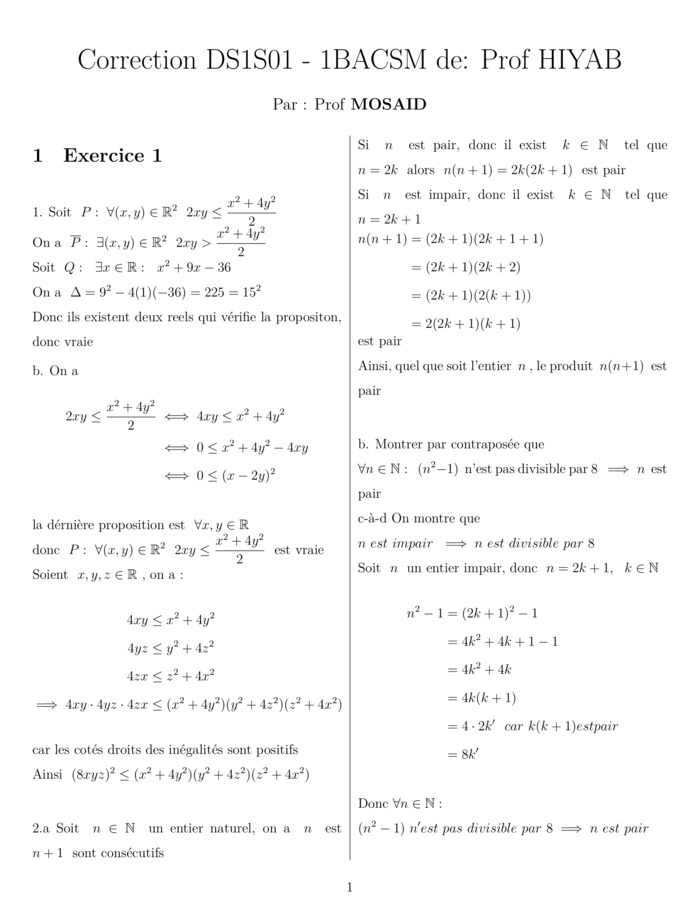
الحل في مادة الرياضيات للمستوى الأولى باك علوم رياضية. يضم الملف عدد التمارين: 3. يمكنك قراءة الملف أو تنزيله مباشرةً بصيغة PDF.
\documentclass[12pt]{article}
\usepackage[left=1cm,right=1cm,top=1.5cm,bottom=1.5cm]{geometry}
\usepackage{amsmath, amsfonts, amssymb, amsthm}
\usepackage{mathtools}
\usepackage{setspace}
\usepackage{fancyhdr}
\usepackage{xcolor}
\usepackage{array}


\usepackage{titlesec}
\titlespacing*{\subsection}{0pt}{0.3cm}{0.2cm}

\usepackage{multicol}

\setlength{\columnseprule}{0.4pt}   % thickness of the vertical line
\setlength{\columnsep}{0.5cm}         % horizontal space between columns

\usepackage{xparse}
\NewDocumentCommand{\no}{m}{\overline{\#1}}

\newcommand{\myrule}{\vspace*{0.3cm}\hrule height 1.5pt\vspace*{0.3cm}}
\newcommand{\bm}[1]{\ensuremath{\boldsymbol{\#1}}}
\newcommand{\rr}{\mathbb{R}}
\newcommand{\Z}{\mathbb{Z}}
\newcommand{\tb}{{\Large\textbullet}}

\setstretch{1.5}
\everymath{\displaystyle}
\setlength{\parindent}{0pt}

\begin{document}

\begin{center}
  {\Huge Correction DS1S01 - 1BACSM de: Prof HIYAB}\\[0.5cm]
  {\large Par : Prof \textbf{MOSAID}}
\end{center}

\begin{multicols*}{2}
\section{Exercice 1}
1. Soit ~$P:~ \forall (x,y)\in \rr^2~~ 2xy\le \frac{x^2+4y^2}{2}$~\\
On a ~$\no P:~ \exists (x,y)\in \rr^2~~ 2xy > \frac{x^2+4y^2}{2}$~\\
Soit ~$Q:~~ \exists x \in \rr :~~x^2+9x-36$~\\
On a ~$\Delta = 9^2-4(1)(-36)=225=15^2$~\\
Donc ils existent deux reels qui vérifie la propositon, donc vraie

b. On a
\begin{align*}
  2xy\le \frac{x^2+4y^2}{2}
  &\iff 4xy \le x^2+4y^2\\
  &\iff 0 \le x^2+4y^2 -4xy \\
  &\iff 0 \le (x-2y)^2
\end{align*}

la dérnière proposition est ~$\forall x,y\in\rr$\\ donc
~$P:~ \forall (x,y)\in \rr^2~~ 2xy\le \frac{x^2+4y^2}{2}$~ est vraie\\
Soient ~$x,y,z\in\rr$~, on a :
\begin{align*}
  4xy &\le x^2+4y^2\\
  4yz &\le y^2+4z^2\\
  4zx &\le z^2+4x^2\\
 \implies 4xy\cdot 4yz\cdot 4zx &\le (x^2+4y^2)(y^2+4z^2)(z^2+4x^2)
\end{align*}
car les cotés droits des inégalités sont positifs\\
Ainsi
~$(8xyz)^2 \le (x^2+4y^2)(y^2+4z^2)(z^2+4x^2)$~\\

2.a Soit ~$n\in \mathbb N$~ un entier naturel, on a ~$n$~ est ~$n+1$~ sont consécutifs\\
Si ~$n$~ est pair, donc il exist ~$k\in\mathbb N$~ tel que ~$n=2k$~
  alors ~$n(n+1)=2k(2k+1)$~ est pair\\
Si ~$n$~ est impair, donc il exist ~$k\in\mathbb N$~ tel que ~$n=2k+1$~\\
~$
\begin{aligned}
  n(n+1)&=(2k+1)(2k+1+1)\\
  &=(2k+1)(2k+2)\\
  &=(2k+1)(2(k+1))\\
  &=2(2k+1)(k+1)
\end{aligned}
$~\\
   est pair\\
  Ainsi, quel que soit l'entier ~$n$~, le produit ~$n(n+1)$~ est pair\\

 b. Montrer par contraposée que\\
  ~$\forall n\in\mathbb N:~~ (n^2-1)$~ n'est pas divisible par 8 ~$\implies n$~ est pair\\
  c-à-d On montre que \\
  ~$n~ est ~impair~\implies n ~ est ~ divisible ~ par ~ 8$~\\
  Soit ~$n$~ un entier impair, donc ~$n=2k+1,~~ k\in\mathbb N$~
  \begin{align*}
    n^2-1&=(2k+1)^2-1\\
    &=4k^2+4k+1-1\\
    &=4k^2+4k\\
    &=4k(k+1)\\
    &=4\cdot2k' ~~ car ~ k(k+1) est pair\\
    &=8k'
  \end{align*}

Donc $\forall n\in\mathbb N:$\\
$ (n^2-1)~n'est~ pas~ divisible~ par~ 8\implies n~ est~ pair$\\

3. Résoudre dans \(\mathbb{R}\) l'équation :\\
        ~$
        (E) : \sqrt{2x - 3} = \frac{6 - x}{\sqrt{x}}
        $~

L'équation ~$(E)$~ a un sens ssi ~$2x-3\ge0 ~~et ~~ x\neq 0$~\\
c-à-d ~$x\ge \frac{3}{2} ~~et ~~ x\neq 0$~\\
Soit ~$x\in \left[\frac{3}{2}, +\infty\right[$~:

\tb si ~$6-x<0$~ c-à-d ~$x>6$~ l'équation est impossible.\\
\tb si ~$x\in\left[\frac{3}{2}, 6\right]$~
\begin{align*}
  (E)&\iff  2x-3=\frac{(6-x)^2}{x}\\
  &\iff 2x^2-3x=36-12x+x^2\\
  &\iff x^2+9x-36=0\\
  &\iff x=\frac{-9-15}{2} ~~ ou ~~x=\frac{-9+15}{2}~\\
  &\iff x=-12 ~~ ou ~~ x=3~
\end{align*}

Alors l'ensemble des solutions de ~$(E)$~ est ~$S=\{3\}$~\\

4. Montrer que :
~$(\forall n \in \mathbb{N}) \quad \sum_{k=0}^{n}(2k + 1) = (n + 1)^2$~

On procède par récurrence:\\

\tb pour ~$n=0$~ : ~$2 \times 0+1 = 0+1$~ est vrai, donc la propositon est vraie pour ~$n=0$~\\
On suppose que
~$\sum_{k=0}^{n}(2k + 1) = (n + 1)^2$\\
et on montre que:
~$\sum_{k=0}^{n+1}(2k + 1) = (n + 2)^2$\\
On a
\begin{align*}
  \sum_{k=0}^{n+1}(2k + 1) &= \sum_{k=0}^{n}(2k + 1) + 2(n+1)+1\\
  &=(n+1)^2+2(n+1)+1\\
  &=(n+1+1)^2\\
  &=(n+2)^2
\end{align*}
\tb Conclusion
~$(\forall n \in \mathbb{N}) \quad \sum_{k=0}^{n}(2k + 1) = (n + 1)^2$~\\
5. Soient \(A\) et \(B\) deux parties d'un ensemble \(E\).\\
      Exprimer à l'aide de quantificateurs la proposition \(R : A \subset B\).

      ~$\forall x\in E;~~ x\in A \implies x\in B$~\\

6.a Montrer que \((\forall n \in \mathbb{N}^*) \quad \sqrt{n^2 + 2n} \notin \mathbb{N}\).\\
On a ~$n^2 < n^2+2n < n^2+2n+1$~\\
Donc ~$n^2 < n^2+2n < (n+1)^2$~\\
Ainsi ~$n < \sqrt{n^2+2n} < n+1$~\\
Alors ~$\sqrt{n^2+2n}$~ ne peut pas etre un entier car il est compris entre deux entiers consécutifs\\
b. Montrer que \((\forall n \in \mathbb{N}^*) \quad \sqrt{\frac{n}{n+2}} \notin \mathbb{Q}\). \\
On a
\begin{align*}
  \sqrt{\frac{n}{n+2}}&=\sqrt{\frac{n(n+2)}{(n+2)^2}}\\
  &=\frac{1}{n+2}\sqrt{n^2 + 2n}\\
\end{align*}

~$\sqrt{\frac{n}{n+2}} \in \mathbb{Q}$~ ssi ~$\sqrt{n^2 + 2n} \in \mathbb{N}$~
ce qui est impossible
selon la question b.a \\
donc

\((\forall n \in \mathbb{N}^*) \quad \sqrt{\frac{n}{n+2}} \notin \mathbb{Q}\). \\

\vspace*{\fill}
\columnbreak

\textbf{\underline{méthode 2:}}

Supposant qu'il existe \( (a, b) \in \mathbb{N} \times \mathbb{N}^* \) tel que
~$
\sqrt{\frac{n}{n+2}} = \frac{a}{b} \implies \frac{n}{n+2} = \frac{a}{b}
$~
\vspace*{-0.5cm}
\begin{align*}
  &\implies nb^2 = na^2 + 2a^2\\[0.3cm]
  &\implies nb^2 - na^2 = 2a^2\\[0.3cm]
  &\implies n(b^2 - a^2) = 2a^2\\[0.3cm]
  &\implies n = \frac{2a^2}{b^2 - a^2}\\[0.3cm]
  &\implies b^2 - a^2 \mid a^2 \quad \text{ou} \quad b^2 - a^2 \mid 2\\[0.3cm]
  \shortintertext{Si $b^2 - a^2$ divise $a^2$, alors $b^2$ divise $a^2$.}
  &\implies b^2 \mid a^2 \quad \text{ou} \quad b^2 - a^2 \mid 2
\end{align*}

\( b^2 \) ne peut pas diviser \( a^2 \) car \( pgcd(a^2, b^2) = 1 \) \\
(puisque \( \frac{a}{b} \) est irréductible, ~$\frac{a^2}{b^2}$~est aussi irréductible).

Ainsi, \( b^2 - a^2 \mid 2 \implies b^2 - a^2 \in \{1, 2\} \).

\vspace*{-1cm}
\begin{align*}
Si~~ b^2 - a^2 = 1 &\implies (b-a)(b+a) = 1 \\
&\implies
\begin{cases}
  b-a=1\\
  b+a=1
\end{cases}\\
&\implies a = 0 ~et~  b=1\\
&ce~ qui~ est~ impossible.
\end{align*}

\vspace*{-1cm}
\begin{align*}
Si~~ b^2 - a^2 = 2 &\implies (b-a)(b+a) = 2 \\
&\implies
\begin{cases}
  b-a=1\\
  b+a=2
\end{cases}\\
&\implies b=1.5 ~et~ a=0.5\\
&ce~ qui~ est~ impossible.
\end{align*}
Conclusion \( (\forall n\in\mathbb N^*):~~ \sqrt{\frac{n}{n+2}} \notin \mathbb{Q} \)

\section{Exercice 2}
Montrer que : ~$A = (A \cup B) \setminus (B \setminus A)$~\\
\textbf{\underline{méthode 1:}}\\
\colorbox{red!30}{%
Remarquer que ~$A\setminus B = A \cap \no B$~
}\\
\vspace*{-1cm}
\begin{align*}
  (A \cup B) \setminus (B \setminus A)
  &=(A \cup B) \setminus (B \cap \no A)\\
  &=(A \cup B) \cap \no {B \cap \no A}\\
  &=(A \cup B) \cap (\no B \cup A)\\
  &=(A \cup B) \cap (A \cup \no B)\\
  &=A \cup (B \cap \no B)\\
  &=A \cup \emptyset \\
  &=A
\end{align*}

\vspace*{-1cm}
\textbf{\underline{méthode 2:}}\\
~$x\in A \implies  x \in A\cup B ~et~ x\not\in B\setminus A$~\\
car $x\in A$~ et $x$~ ne peux pas appartenir à B sans appartenir à A \\
donc ~$x \in (A \cup B) \setminus (B \setminus A)$~\\
Ainsi ~$A \subset (A \cup B) \setminus (B \setminus A)$~ \hfill (1)

On a\\
~$  x \in (A \cup B) \setminus (B \setminus A)$~
~$  \implies  x \in A\cup B ~et~ x\not\in (B\setminus A)$\\
puisque ~$x\in (A \cup B)$~ alors ~$x\in A$~ ou ~$x\in B$~\\
\tb Si ~$x\in A$~ c'est notre but \\
\tb Si ~$x\in B$~ \\
alors  ~$x\not\in (B\setminus A)$~ implique que ~$x\in A$~\\[0.2cm]
\colorbox{red!30}{%
  \parbox{\dimexpr\linewidth-2\fboxsep\relax}{%
    parce que ~$x\notin (B\setminus A) \iff x\notin (B\cap \no A)$~\\
    autrement dit :\\ puisque ~$x\in B$~ et ~$x\notin (B\cap \no A) $~ alors ~$x\notin \no A$~\\
    d'où ~$x\in A$~
  }%
}\\

Ainsi ~$(A \cup B) \setminus (B \setminus A) \subset A$~ \hfill (2)

De (1) et (2), on conclut que ~$A = (A \cup B) \setminus (B \setminus A)$~.

On a\\
\begin{tabular}{>{$}r<{$}>{$}l<{$}}
  A\setminus(A\cap B)&=A\cap\no{A\cap B}\\
  &=A\cap(\no A \cup \no B)\\
  &=(A\cap \no A)\cup (A\cap \no B)\\
  &=\emptyset \cup (A\cap \no B)\\
  &=A\cap \no B\\
  &= A\setminus B
\end{tabular}

1.b On a \\
~$A \cup B = \{1; 2; 3; \dots; 11\}$~ ;
~$A \cap B = \{4; 5; 6; 11\}$~ et
~$B \setminus A = \{7; 8; 9; 10\}$~\\
Déterminer et justifier les ensembles : \(A\), \(A \setminus B\) et \(A \triangle B\).

On a
~$A = (A \cup B) \setminus (B \setminus A)$~\\
Donc ~$A=\{1,2,3,4,5,6,11\}$~\\

On a
~$A \setminus B = A \setminus (A \cap B)$~

Donc ~$A\setminus B=\{1,2,3\}$~

rappel
\colorbox{red!30}{%
  ~$A \triangle B = (A \setminus B) \cup (B \setminus A)$~
}

donc ~$A \triangle B =\{1,2,3,7,8,9,10\}$~

2. On a
      ~$C = \left\{ \frac{19\pi}{10} + \frac{k\pi}{5} \mid k \in \mathbb{Z} \right\}$~
      Donc

\begin{tabular}{>{$}r<{$}>{$}l<{$}}
  x\in C &\iff x = \frac{19\pi}{10} + \frac{k\pi}{5} ~~~;~ k \in \mathbb{Z}\\[0.3cm]
  &\iff  x = \frac{1}{10}\left( 19\pi +2k\pi \right)  ~~~;~ k \in \mathbb{Z}\\
  &\iff  x = \frac{1}{10}\big( -3\pi + 20\pi +2 \pi +2k\pi \big) \\
  &\iff  x = \frac{1}{10}\big( -3\pi + 20\pi +2(k+1)\pi \big)  \\
  &\iff  x = \frac{-3\pi}{10}+2\pi + \frac{(k+1)\pi}{5} \\
  &\iff  x = \frac{-3\pi}{10}+ \frac{(k')\pi}{5}  ~~~;~ k'=k+1 \in \mathbb{Z}\\[0.3cm]
  &\iff  x = \frac{-3\pi}{10}- \frac{k''\pi}{5}  ~~~;~ k''=-k \in \mathbb{Z}\\
  &\iff  x \in D\\
\end{tabular}

Alors ~$C=D$~
Note: Peut etre le prof a fait une faute de frappe ici, je ne vois pas l'interet
à changer ~$+k\pi$~ en ~$-k\pi$~
\section{Exercice 3}
1. a On a ~$A\cap B\subset A$~ et ~$A\subset A\cup B$~ donc ~$A\cap B \subset A\cup B$~
b. On a


\begin{tabular}{>{$}r<{$}>{$}l<{$}}
  (A\triangle B) \cup (\no{A\cup B})
  &= (A\setminus B \cup B\setminus A) \cup (\no A \cap \no B)\\
  &= [(A\cap \no B)\cup (B\cap \no A)] \cup (\no A \cap \no B)\\
 U ~commutatif &= (A\cap \no B)\cup (\no A \cap \no B)\cup (B\cap \no A) \\
  &= \no B\cap (A \cup \no A )\cup (B\cap \no A) \\
  &= (\no B\cap E)\cup (B\cap \no A) \\
  &= \no B\cup (B\cap \no A) \\
  &= (\no B\cup B)\cap (\no B\cup \no A) \\
  &= E\cap (\no B\cup \no A) \\
  &= \no B\cup \no A \\
  &= \no {B\cap  A} \\
\end{tabular}

ou

\begin{tabular}{>{$}r<{$}>{$}l<{$}}
  (A\triangle B) \cup (\no{A\cup B})
  &= (A\setminus B \cup B\setminus A) \cup (\no A \cap \no B)\\
  &= [\bm{(A\cap \no B)\cup (B\cap \no A)}] \cup (\no A \cap \no B)\\
  U ~associatif &= (A\cap \no B)\cup [\bm{(B\cap \no A) \cup (\no A \cap \no B)}]\\
  &= (A\cap \no B)\cup  [\bm{\no A \cap (B\cup \no B)}]\\
  &= (A\cap \no B)\cup  (\no A \cap E)\\
  &= (A\cap \no B)\cup  \no A \\
  &= (A\cup \no A)\cap  (\no B \cup \no A) \\
  &= E\cap (\no B\cup \no A) \\
  &= \no B\cup \no A \\
  &= \no {B\cap  A} \\
\end{tabular}

c. On a


\begin{tabular}{>{$}r<{$}>{$}l<{$}}
\begin{cases}
(B\setminus C)\subset A  \\
(C \setminus D)\subset A
\end{cases}
&
\implies
\begin{cases}
  (B\cap \no C) \subset A \\
  (C\cap \no D) \subset A \\
\end{cases}\\
&
\implies
\begin{cases}
  B \subset A ~~et~~ \no C \subset A \\
  C \subset A ~~et~~ \no D \subset A \\
\end{cases}\\
&\implies B\subset A ~~ et ~~ \no D \subset A\\
&\implies (B\cap \no D)\subset A \\
&\implies (B\setminus D)\subset A
\end{tabular}

\end{multicols*}
2. On suppose dans cette question que :\\
~$A = \{2k + 6 \mid k \in \mathbb{Z}\}$~ et
~$B = \{2k + 3 \mid k \in \mathbb{Z}\}$~\\
Montrer que \(\mathbb{Z} \subset (A \cup B)\) et en déduire que \(A \cup B = \mathbb{Z}\).

On a ~$A= \{2k+6,~~k\in \Z\}$~ \\c-à-d
~$A= \{2(k+3),~~k\in \Z\}$~
c'est l'ensemble des entiers relatifs pairs\\
On a
~$B = \{2k + 3 ,~~~ k \in \mathbb{Z}\}$~ \\c-à-d
~$B = \{2(k+1) + 1 ,~~~ k \in \mathbb{Z}\}$~
c'est l'ensemble des entiers relatifs impairs\\
~$A\cup B$~ est l'ensemble des entiers relatifs pairs et impairs\\
il est evident que ~$\Z \subset (A\cup B)$~ \hfill (1)

puisque ~$A\subset \Z$~ et ~$B\subset \Z$~
alors ~$(A\cup B)\subset \Z$~\hfill (2)

De (1) et (2) on déduit que ~$\Z=A\cup B$~

3. On a :\\
~$A = \{(x, y) \in \mathbb{R}^2 \mid x - 2y = 1\}$~ et
~$B = \{(3 + 2t; 1 + t) \mid t \in \mathbb{R}\}$~

\tb pour ~$t=1$~:~$3+2(1)=5$~ et ~$1+1=2$~ donc ~$(5,2)\in B$~\\
\tb pour ~$t=0$~ on a ~$3+2(0)=3$~ et ~$1+0=1$~ donc ~$(3,1)\in B$~\\
On a ~$3-2(1)=1$~ donc ~$(3,1)\in A$~\\
Ainsi, ~$(3,1)\in A\cap B$~\\

note:\\ si l'etudiant n'a pas remarquer les valeurs de t, il suffit de résoudre les équations ~$3+2t=5$~ et ~$1+t=2$~ et trouver une seule valeur de t

On a ~$(x,y)\in B \iff
\begin{cases}
  x=3+2t\\
  y=1+t
\end{cases}
$~
~$
\iff
\begin{cases}
  x=3+2t\\
  2y=2+2t
\end{cases}
\iff x-2y=1
$~
~$\iff (x,y) \in A$~\\
Ainsi ~$A=B$~

On a ~$(0,0)\not\in A$~ donc ~$\rr^2 \not\subset A$~\\

\hfill  In \today, by MOSAID


\end{document}
موارد ذات صلة: دروس وامتحانات وتمارين
يمكنك الاطلاع على المزيد من موارد الرياضيات للمستوى الأولى باك علوم رياضية.
📄 هل تحتاج تنسيقًا بـ LaTeX؟
أرسل لي واجبك أو امتحانك أو تمارينك وسأحوّلها إلى ملف PDF احترافي.
اعرف المزيد ←أحدث الدروس
الأكثر مشاهدة
Tous les sujets des suites numériques des examens nationaux 2008 - 2022
views: 3.19K
امتحان • Maths • 2 Bac Science

Control 01 S01 En arithmétiques et Calcul vectoriel - A 2025-2026
views: 2.18K
امتحان • Maths • Tronc Commun Sciences
DM 1 - Arithmetiques, Calcul vectoriel et projection
views: 2.00K
امتحان • Maths • Tronc Commun Sciences
MATHEMATIQUES Examens nationaux 2003-2021 2 Bac.Sciences expérimentales
views: 1.99K
امتحان • Maths • 2 Bac Science
Recent Articles




A Conky Classroom Clock for Tracking Lesson Time
19 Nov 2026

A Tiny Bash Todo List That Greets Every Terminal
19 Nov 2026

Most Viewed Articles



The Ultimate Vim Setup (My 2024 vimrc ) : Essential Commands, Configurations, and Plugin Tips
Views: 1.50K
12 Apr 2024
Complete Tutorial: Creating Categories and Subcategories Using Pages in Pelican
Views: 1.15K
24 Jun 2025
اترك تعليقًا